

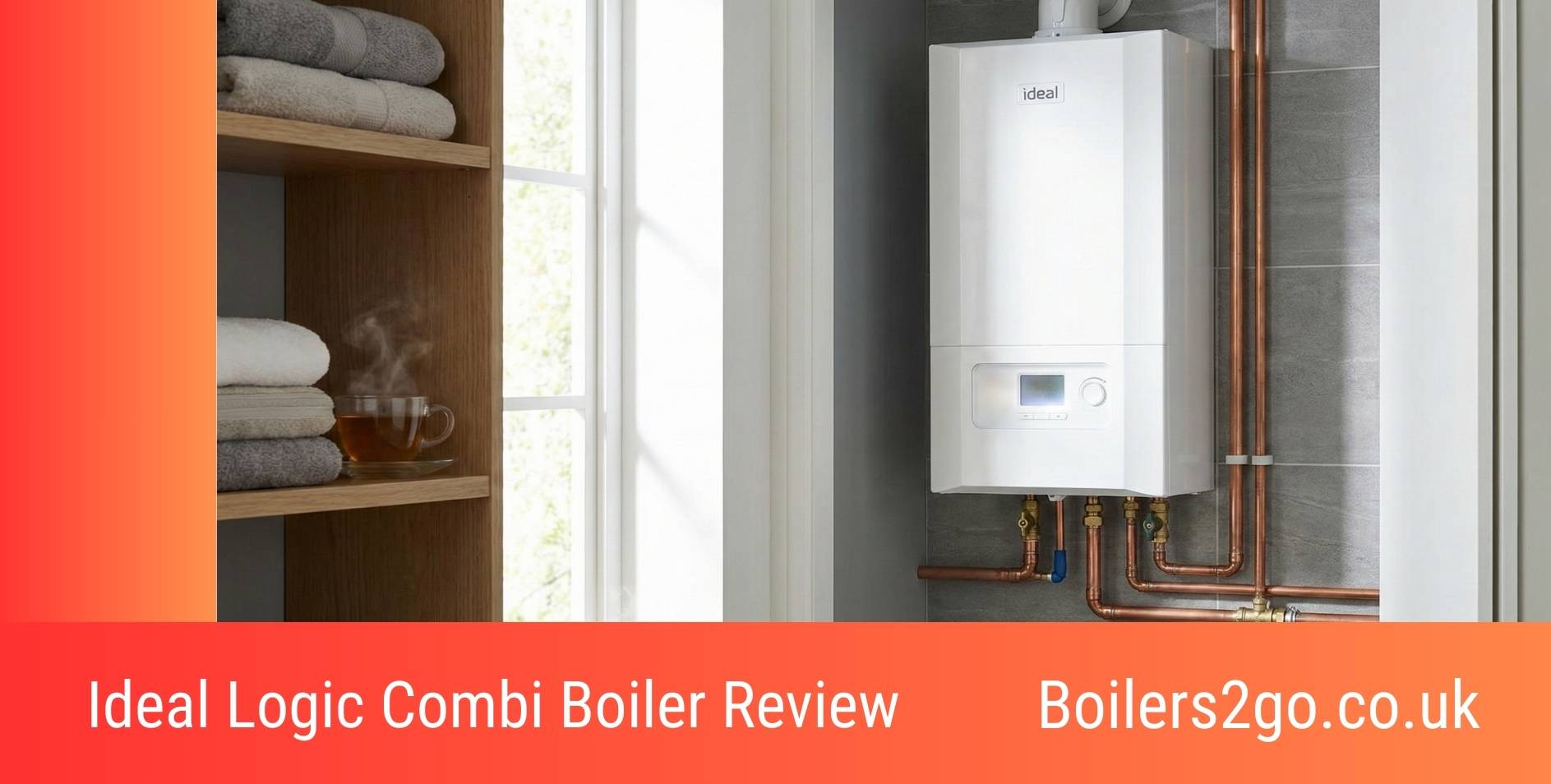
The Ideal Logic Max is one of the best-selling combi boilers in Britain, and for most people replacing an ageing combi it’s a sensible, unexciting, entirely defensible choice. It’s made in Hull, parts are everywhere, and it carries a 10-year parts and labour warranty at a price that undercuts the equivalent Worcester Bosch by a couple of hundred pounds. For the wider brand picture, see our Ideal boiler reviews.
There’s one thing about it that almost nobody explains properly, and it changes how you should size it. That’s covered below, along with what it costs fitted this winter and the parts of the installation that decide whether the warranty is worth anything.
Ideal Logic vs Logic Max: Which One Are You Being Quoted?
Ideal’s tiers are easy to muddle, and the warranty gap between them is enormous. This trips up more buyers than any other detail, and our Ideal boiler warranty guide sets out the terms.
| Model | Standard warranty | What you get |
|---|---|---|
| Logic Combi | 2 years | The bare-bones entry model. No system filter supplied |
| Logic Max Combi | 10 years | The volume seller. Ideal System Filter included, colour display, service reminder |
That first row is the one to watch. A standard Logic Combi carries a two-year warranty, not the five to seven years often quoted second-hand. If a quote says “Ideal Logic 30” without the word Max, you are looking at a materially different boiler with a fraction of the cover. Ask which one, in writing. If that is the model you have been quoted, our Ideal Logic C30 combi boiler review looks at the standard version’s costs, specs and trade-offs in more detail.
The older Logic+ generation, which had a seven-year warranty, has been superseded by the Logic2 range. You may still see Logic+ stock at merchants.
Ideal Logic Max Combi Specifications: kW Output, Flow Rate and Dimensions
Straight from Ideal’s published product data.
| Logic Max C24 | Logic Max C30 | Logic Max C35 | |
|---|---|---|---|
| CH output (max, 70°C mean) | 24.2 kW | 24.2 kW | 24.2 kW |
| CH output (max, 40°C mean) | 25.6 kW | 25.6 kW | 25.6 kW |
| CH output (minimum) | 4.8 kW | 6.1 kW | 7.1 kW |
| Hot water output (max) | 24.2 kW | 30.3 kW | 35.3 kW |
| Hot water flow rate (35°C rise) | 9.9 l/min | 12.4 l/min | 14.5 l/min |
| Seasonal efficiency | 94%, ErP A | 94%, ErP A | 94%, ErP A |
| Sound power indoors | 50 dB(A) | 46 dB(A) | 46 dB(A) |
| Max horizontal flue | 9 m | 8 m | 6 m |
| Max vertical flue | 7.7 m | 7.5 m | 7.5 m |
| Packaged weight | 32.8 kg | 33 kg | 33 kg |
| Installation weight | 28.5 kg | 28.6 kg | 28.6 kg |
| Dimensions (H×W×D) | 700 × 395 × 278 mm | Same | Same |
| NOx class | Class 6 | Class 6 | Class 6 |
| LPG conversion | Yes | Yes | Yes |
| Warranty | 10 years | 10 years | 10 years |
The Thing Nobody Tells You: All Three Logic Max Models Have the Same Heating Output
Look at the top row again. The C24, C30 and C35 all produce a maximum 24.2 kW of central heating. They are identical on the heating side.
The number in the model name is the hot water output. Going from a C24 to a C35 buys you more hot water and nothing else. It does not heat more radiators, it does not warm the house faster, and it will not fix a cold back bedroom.
This matters because plenty of people are talked into a 35 on the basis that they have a big house. If your radiator load genuinely exceeds 24 kW, no Logic Max combi is the answer and you should be looking at a system boiler with a cylinder. If your radiator load is under 24 kW, which covers the overwhelming majority of UK homes, then size purely on hot water demand.
One useful side effect: the smaller models modulate down further. The C24 turns down to 4.8 kW against the C35’s 7.1 kW. In a well-insulated house in mild weather, the C24 will cycle less and run more efficiently. Oversizing has a real cost.
Why Ideal Logic Max Flow Rates Drop in Winter
Every manufacturer quotes hot water flow at a 35°C temperature rise. Mains water in a British January sits around 5 to 8°C, so a decent 40°C shower needs more than a 35°C rise, and actual flow drops accordingly.
Treat the C30’s 12.4 l/min as roughly 10 to 11 l/min in February. For one bathroom, the C24 or C30 is fine. For two bathrooms in genuine simultaneous use, a combi is the wrong appliance regardless of badge number.
Ideal Logic Max Pros: System Filter, Quiet Running and Cheap Parts
The 10-year parts and labour warranty is the headline, and at this price point it’s a genuinely strong offer.
The Ideal System Filter is supplied with the boiler. Worth being precise here, because it’s frequently misdescribed: this is a 22mm brass filter that comes in the box and gets plumbed onto the return, not something built inside the appliance. It catches the sludge that would otherwise wreck the heat exchanger. Included as standard is unusual at this money.
It’s genuinely quiet. On Ideal’s published figures, the C30 and C35 are rated at 46 dB(A). Note the quirk: the C24 is the loudest at 50 dB(A). If the boiler is going in a cupboard off a bedroom, the C30 is the quieter choice.
Parts availability and repair cost are where Ideal quietly wins. Every merchant stocks Logic parts, every engineer has worked on one, and a repair out of warranty is rarely an ordeal. That’s worth more over fifteen years than most spec-sheet features.
Installer-friendly matters to your wallet too. Compact cupboard fit, easy filling loop, accessible pressure gauge. Quicker fits and quicker services mean cheaper labour.
It’s also compatible with Ideal’s Halo smart thermostat range, and fitting a Halo Combi raises the ErP package label to A+.
Ideal Logic Max Cons: Aluminium Exchanger and Service Reputation
The heat exchanger is aluminium, not stainless steel. Aluminium conducts heat well and keeps costs down, but it’s less tolerant of poor water chemistry than stainless. In a hard-water area, or on an old sludged system that isn’t properly cleaned at installation, that’s a real long-term risk. This is precisely why the supplied filter and a proper cleanse are not optional extras. If a stainless exchanger is a priority for you, you’ll need to look further up the market.
Earlier Logic generations had a patchy reputation for heat exchanger and sump issues. The current range has largely moved past it, but the reputation lingers and it’s fair to acknowledge.
Customer service reviews are mixed, particularly around warranty claims. The practical defence is documentation: registration confirmation, dated service records, and an installer who’ll advocate for you.
No stainless, no premium controls, no design flourish. It’s a competent white box. That’s the deal you’re getting.
How Much Does an Ideal Logic Max Combi Cost Fully Installed in 2026?
Ideal boiler units run roughly £620 to £1,350 in 2026 depending on model and output, sitting around £200 to £300 below equivalent Worcester Bosch models. A Logic Max C30 typically works out at £1,526 to £2,026 for unit and installation on a straightforward job.
For wider context, the median UK quote for a like-for-like combi swap in 2026 is about £2,300, with most simple jobs falling between £2,150 and £3,000. A Logic Max should land at or below that median. Budget £1,800 to £2,600 fitted for a straight swap.
Complications push it up fast. Moving the boiler, rerouting the flue, converting from a heat-only system, or replacing a back boiler commonly runs £3,500 to £5,000.
Get three itemised quotes. A complete one includes the boiler, flue and fittings, the system filter, removal and disposal of the old unit, all labour, commissioning, your Building Regulations certificate and warranty registration. Suspiciously cheap usually means something on that list is missing.
Ideal Logic Max Installation in the UK: Regulations, Warranty and Winter Setup
The boiler is roughly half the outcome. Here’s the half that decides whether you get ten quiet years or a fight in year four.
Register the Ideal Logic Max Warranty Within 30 Days
Ideal’s 10-year parts and labour cover requires registration within 30 days of installation and an annual service thereafter. Miss the window and you’re outside the terms. Miss a service and cover can lapse.
Do three things: get written confirmation from your installer that registration is done, keep the confirmation somewhere you’ll find it in eight years, and diary the annual service now. A standard service runs £70 to £120.
Does the Ideal Logic Max Meet Boiler Plus Regulations?
Comfortably. Boiler Plus has applied in England since 2018 and requires a minimum 92% ErP efficiency plus one of four control measures: load compensation, weather compensation, a smart thermostat with automation and optimisation, or flue gas heat recovery. Scotland, Wales and Northern Ireland run their own similar rules.
At 94% seasonal efficiency the Logic Max clears the efficiency bar. For the control requirement you have two sensible routes: Ideal’s Weather Compensation Kit, which adjusts flow temperature against outdoor conditions with no input from you, or a Halo smart thermostat, which also lifts the ErP package label to A+.
Weather compensation is usually cheaper and saves more gas in practice. Ask your installer which option they’ve priced, because many default to whichever stat they have in the van.
Make Sure the Ideal System Filter Gets Fitted
The Ideal System Filter ships in the box with every Logic Max. It does not fit itself. On rushed jobs it occasionally ends up in the back of the van or left in the packaging.
Check it’s plumbed onto the return before the engineer leaves, and ask to see it. On an aluminium heat exchanger it’s the single cheapest bit of protection you own, and its absence is exactly the sort of thing that gets a warranty claim questioned later.
While you’re at it: the system should be cleansed and dosed with inhibitor to BS 7593 standards. On an old radiator circuit that means a genuine flush, not a capful of chemical through the filling loop.
Check the Flue Run Before Choosing an Ideal Logic Max Output
Here’s a constraint that catches people out. Maximum horizontal flue length varies by model: 9 m on the C24, 8 m on the C30, but only 6 m on the C35.
If the boiler is going somewhere with a long flue run, an internal wall, or an awkward route to an outside wall, the C35 may simply not be viable in that position. Worth establishing at survey rather than on install day. Vertical runs are 7.7 m on the C24 and 7.5 m on the others.
All three convert to LPG if you’re off the gas grid.
What Flow Temperature Should an Ideal Logic Max Be Set To?
Part L now pushes new and fully replaced wet heating systems toward a maximum design flow temperature of 55°C where reasonably practicable. This isn’t paperwork. A condensing boiler only reaches its advertised efficiency when return water is cool enough to condense. Leave a Logic Max running at 75 or 80°C and you’ve bought a 94% boiler and are operating it like a 1990s one.
Ask the installer to commission it for your actual radiators rather than leaving factory settings. Five minutes, and it saves money every winter you own it.
How to Stop the Ideal Logic Max Condensate Pipe Freezing
The most common cold-snap boiler lockout in Britain is a frozen condensate pipe. If any of the run is external, insist on 32mm pipe rather than 22mm, keep the external section as short as possible, insulate it properly, and terminate into a gully where you can.
Costs almost nothing at installation. Costs you a no-heat callout on the coldest morning of the year when every engineer for twenty miles is already booked.
If it does freeze, the boiler will lock out and display a fault. Thawing the external pipe with warm — not boiling — water and then resetting the boiler usually clears it; see how to reset an Ideal Logic combi boiler.
Is the Ideal Logic Max Combi the Right Boiler for Your Home?
Yes, if you want a long warranty, cheap parts and dependable performance without paying a brand premium. For a one-bathroom home with a normal radiator load, it’s very hard to argue against. To see how Ideal compares with Worcester Bosch, Vaillant and Viessmann, see our guide to the best boiler brands.
Think harder about it if you’re in a hard-water area on an old, sludged system, where a stainless steel heat exchanger would be the more forgiving choice.
Look at a system boiler entirely if you have two bathrooms in genuine simultaneous use, or a heating load above 24 kW.
Size it on hot water, not on the badge number. Get the filter fitted, register within 30 days, sort the condensate pipe properly, and have the flow temperature commissioned rather than left at default. Do that and this is a boiler that should sit quietly on the wall for well over a decade.

I’m Penny North, a home energy heating expert. My mission is to demystify new boilers and complex heating systems to help you achieve a warm, cosy home with lower energy bills and a smaller environmental footprint.