

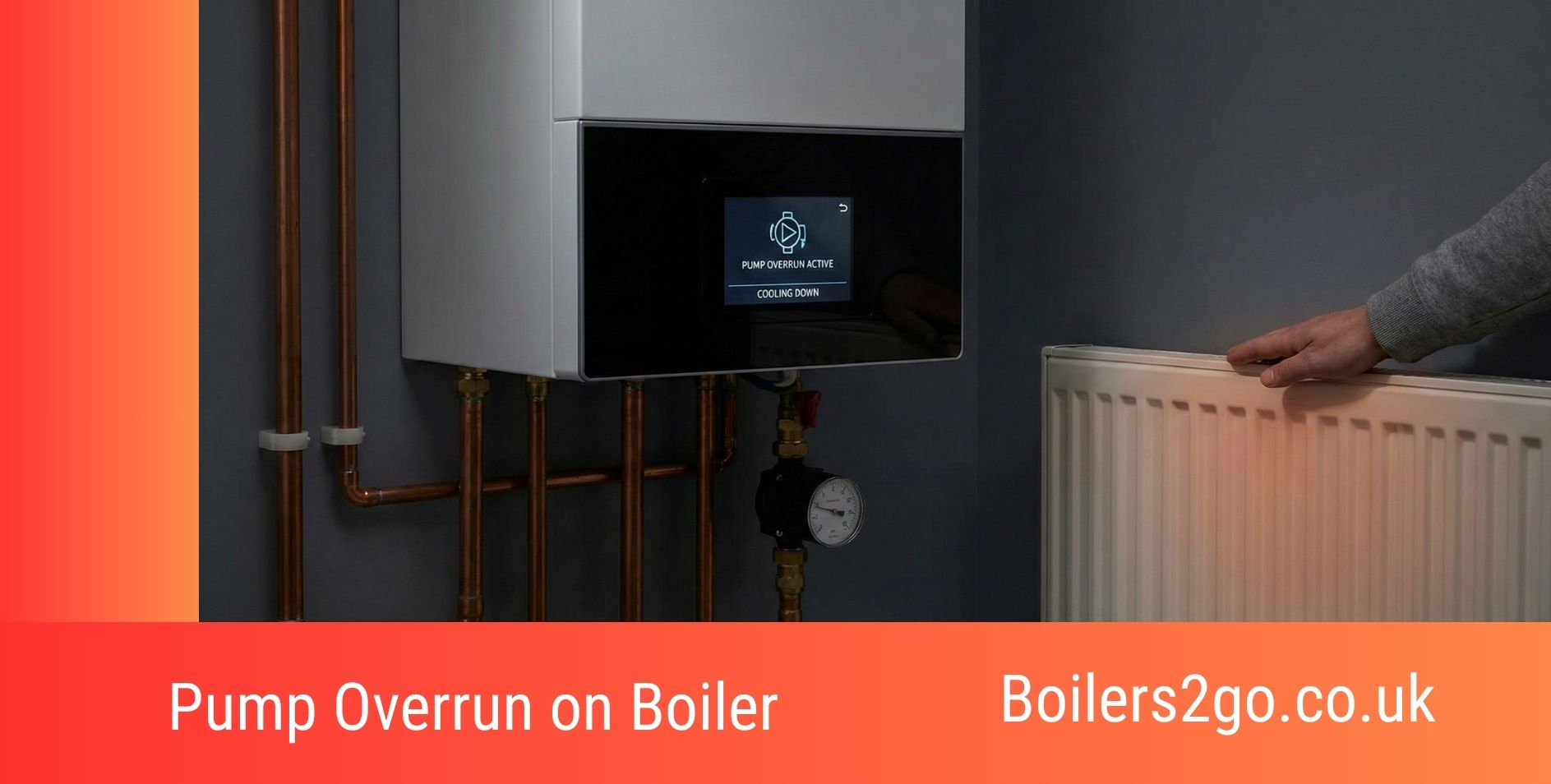
If your boiler is displaying a fault code after switching off, making noises while the pump continues to run, or locking out shortly after a heating cycle ends, pump overrun is likely involved. Understanding what is normal and what points to a genuine fault is the fastest way to decide whether you need an engineer.
Pump overrun is a normal and essential safety feature on all modern UK boilers, but when it fails to operate correctly, it can trigger fault codes, lockouts, and boiler shutdowns.
If pump faults keep coming back, a boiler cover, repair and annual service plan bundles repairs and servicing together.
Pump Overrun on a Boiler: Video Guide
What Is Pump Overrun on a Boiler?
Pump overrun is a built-in safety function that keeps the central heating pump running for a short period, typically 1 to 10 minutes, after the burner has turned off. The pump continues circulating water through the heat exchanger to remove residual heat and prevent the boiler from overheating, boiling, or kettling.
Almost all condensing combi and system boilers sold in the UK since the early 2000s include this feature. It is required under Building Regulations to protect the heat exchanger and improve overall system efficiency. If you hear the pump running briefly after the heating switches off, this is the pump overrun working exactly as designed.
The pump overrun typically lasts between 1 and 5 minutes after the burner shuts off. A duration beyond 10 minutes continuously, or a pump that runs non-stop, points to a fault rather than normal operation.
Why Does Pump Overrun Sometimes Cause Fault Codes?
When the pump overrun function fails, many boilers detect the problem and respond with a fault code or lockout. The most common fault codes linked to pump overrun issues across UK brands are:
- Worcester Bosch: F0, E9, or a “Pump Overrun Fault” message
- Vaillant ecoTEC: F62, F63, or S.53
- Ideal Logic / Max: F4 or L4
- Baxi / Potterton: E133 or E168
- Glow-worm: F22 or pump-related errors
These codes typically mean the pump did not run, or did not run long enough, after the flame went out.
What Causes Pump Overrun Faults on a Boiler?
The following are the most common causes UK homeowners and landlords encounter, roughly in order of how often they appear in practice. Several of them, such as sludge and low pressure, are also behind other common boiler problems.
1. Faulty or Seized Central Heating Pump
The pump itself is the most common culprit behind a pump overrun fault. After 8 to 12 years of constant use, the motor burns out or the impeller seizes, usually due to sludge or limescale build-up restricting its movement. Our boiler pump not working guide covers the wider signs of pump failure.
How to Fix a Faulty or Seized Pump
- Reset the boiler and listen carefully. A pump that is seized will often hum quietly but produce no water movement and no circulation noise.
- With the boiler off and fully cool, some pumps have a centre bleed screw that can be loosened slightly to release trapped air, which occasionally frees a lightly seized impeller. This is one of the few limited things a non-engineer can attempt on a pump.
- If the pump is humming but not turning, or completely silent, it needs replacing. This is a Gas Safe job. Pump replacement in 2025/2026 typically costs £200 to £380 including parts and labour depending on the boiler make and location.
2. Blocked or Stuck Motorised Valve
On system and conventional boilers, motorised valves (2-port or 3-port) control water flow between zones. A valve stuck in the wrong position can prevent the pump from running correctly on overrun. This is more common after a period of system inactivity or in systems without inhibitor.
How to Fix a Stuck Motorised Valve
- Locate the valve, usually near the hot water cylinder or in the airing cupboard.
- The actuator head can often be removed without draining the system. Switch it to manual for a few minutes to free it, then back to auto and test.
- If the valve motor has failed entirely, replacement costs £130 to £270 fitted. A Gas Safe engineer should carry out this work.
3. Printed Circuit Board (PCB) Fault
The PCB controls the pump overrun timer and monitors whether the pump is running correctly. A failed relay or component on the board can cause the pump overrun to trigger incorrectly or not at all. PCB faults become significantly more common after 8 to 12 years.
How to Fix a PCB Fault
PCB diagnosis and replacement is not a DIY job. A Gas Safe engineer will test the board with a multimeter and replace it if necessary. PCB replacement typically costs £300 to £550 including labour, so if the boiler is already over 10 years old it is worth discussing with your engineer whether to repair or replace the boiler.
4. Wiring or Relay Issue Between PCB and Pump
Loose, corroded, or burnt wiring between the PCB and the pump can stop the overrun signal reaching the pump at all. This is more common on older installations where the wiring loom has been disturbed by previous servicing or where the boiler sits in a damp location.
How to Fix Wiring or Relay Problems
A qualified engineer needs to safely check voltages and connections. Minor wiring repairs and relay replacements typically cost under £150. A full wiring harness replacement is more involved and the engineer will advise based on what they find.
5. Airlock or Sludge in the System
Thick black magnetite sludge or an airlock in the pump can restrict its ability to turn, triggering the overrun protection. This is particularly common in systems that have never been flushed or treated with inhibitor, and in properties with hard water where scale builds up inside the pump body over time. Our guide to central heating sludge explains how to remove it.
How to Fix Sludge or Airlock Issues
- Bleed all radiators starting from the ground floor upwards and check the pressure is between 1.0 and 1.5 bar. This clears any airlock that may be restricting the pump.
- If the system water runs dark grey or black when you bleed a radiator, sludge contamination is the likely cause. A full powerflush typically costs £350 to £800 in 2025/2026 depending on property size and the number of radiators. Fitting a magnetic system filter (MagnaClean, Fernox TF1) at the same time prevents re-contamination.
6. Low System Pressure or Faulty Pressure Sensor
Many boilers check system pressure as a precondition before allowing the pump overrun to operate. If pressure has dropped below around 0.5 bar, or if the pressure sensor itself is reading incorrectly, the overrun function can be blocked entirely. Our low boiler pressure guide covers the common causes.
How to Fix Low Pressure
- Check the pressure gauge. For most UK boilers it should read 1.0 to 1.5 bar when the system is cold. If it has dropped, top up via the filling loop slowly until it reaches 1.2 bar. Avoid overfilling, as going well above 1.5 bar when cold causes the opposite problem, explained in our guide to why your boiler pressure is too high.
- If pressure drops again within a few days of topping up, there is a leak somewhere in the system. A Gas Safe engineer will need to trace and seal it.
- If pressure is correct but the fault code still points to a pressure issue, the sensor itself may have failed and will need testing and replacement by an engineer.
How to Prevent Pump Overrun Faults
Most pump overrun faults are preventable. The following habits keep the system in good condition and reduce the chance of the pump failing prematurely:
- Book an annual boiler service. A Gas Safe engineer will test the pump operation, check valve movement, and address early signs of sludge or scale before they cause a fault.
- Fit a magnetic system filter (Adey MagnaClean, Fernox TF1) and clean it at every annual service. Magnetite sludge is a leading cause of pump seizure.
- Keep system pressure between 1.0 and 1.5 bar. Low pressure puts additional strain on the pump every time the overrun cycle triggers.
- Have inhibitor concentration checked at every service and topped up as needed. This prevents the internal corrosion that generates sludge in the first place.
- If your boiler is over 10 years old and pump faults are recurring, get a new boiler quote to compare the cost of ongoing repairs against a modern replacement. New boilers have considerably more reliable pumps and PCBs than those fitted a decade ago.
When to Call a Gas Safe Engineer About Pump Overrun
Call a registered Gas Safe engineer immediately if any of the following apply:
- You can smell gas or hear hissing from the boiler.
- The boiler is leaking water.
- You have reset the boiler more than twice and the fault code returns immediately.
- The fault code is accompanied by no heating and no hot water, particularly during cold weather.
- You are not confident about any aspect of the system. DIY checks are limited to pressure, bleeding radiators, and a pump bleed screw: anything involving electrics, gas, or sealed system components must be carried out by a qualified professional.
You can verify any engineer’s Gas Safe credentials before they arrive using the Gas Safe Register engineer finder. If you smell gas at any point, do not operate any switches: leave the property and call the National Gas Emergency Service on 0800 111 999.
Pump Overrun on a Boiler: FAQs
Is Boiler Pump Overrun Normal?
Yes, in most cases it is completely normal. The pump continuing to run for 1 to 10 minutes after the burner shuts off is the overrun function working correctly. You may hear the pump running and the boiler making circulation noises. This is not a fault. The situation that needs attention is when the pump continues running for more than 10 minutes non-stop, or when the boiler displays a fault code alongside the overrun behaviour.
Can I Free a Seized Boiler Pump Myself?
Only in a limited way. Some pumps have a centre bleed screw on the pump body that, when loosened slightly with a flat-head screwdriver (boiler off and cool), allows trapped air to escape and can occasionally free a lightly seized impeller. Beyond this, any internal work on the pump or boiler components must be carried out by a Gas Safe registered engineer. Attempting more than this risks invalidating your warranty and creating a safety risk.
How Long Does a Central Heating Pump Last?
A quality central heating pump from a recognised brand (Grundfos, Wilo, Salamander) typically lasts 10 to 15 years with annual servicing and clean system water. In systems without inhibitor or a magnetic filter, sludge and corrosion can significantly shorten this to 6 to 8 years. The pump is one of the most frequently replaced components in older boiler systems.
How Much Does a Central Heating Pump Replacement Cost in 2026?
A central heating pump replacement by a Gas Safe engineer currently costs between £200 and £380 in most parts of the UK, covering both the part and labour. Costs tend to be at the higher end in London and the South East where engineer rates are generally higher. Some boiler cover plans include pump replacement, which can make the repair effectively free if you have the right level of cover.
Can Sludge Cause a Pump Overrun Fault?
Yes, and this is one of the more common causes in older UK systems. Thick magnetite sludge restricts the pump impeller, reducing circulation and making the pump struggle to move water fast enough during the overrun cycle. The boiler detects this as a pump fault and locks out. A powerflush followed by a magnetic filter installation is the correct fix, not just a pump replacement, since a new pump in an unclean system will fail again within a few years.
What Is the Difference Between Normal Pump Overrun and a Fault?
Normal pump overrun: the pump runs for 1 to 10 minutes after the burner shuts off, the boiler displays a normal status indicator, and heating and hot water work correctly between cycles. Pump overrun fault: the boiler locks out with a specific fault code (such as E9, F62, or L4 depending on the brand), the pump may run continuously without stopping or fail to run at all, and the boiler cannot complete a normal heating cycle.

I’m Penny North, a home energy heating expert. My mission is to demystify new boilers and complex heating systems to help you achieve a warm, cosy home with lower energy bills and a smaller environmental footprint.