

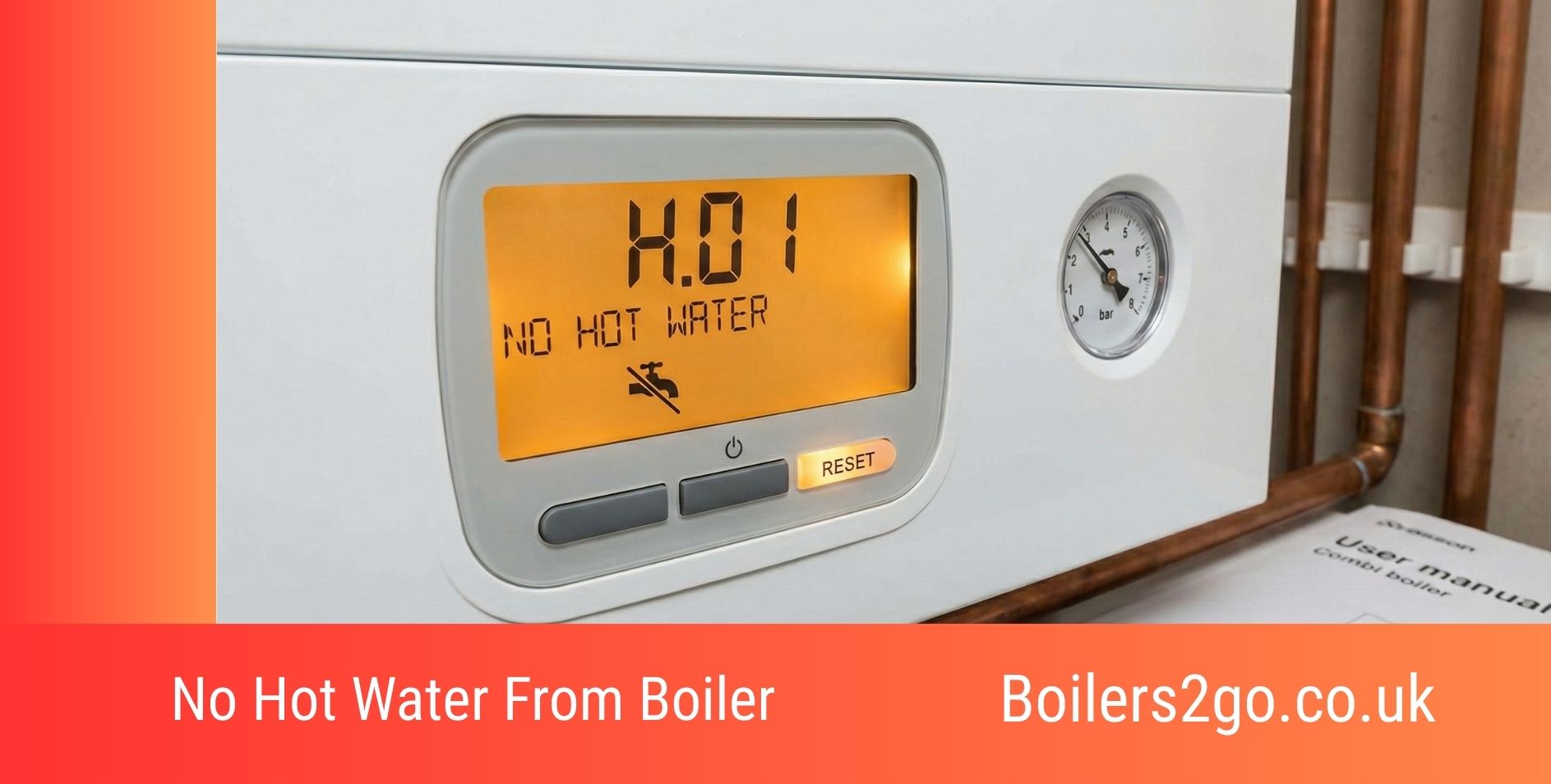
No hot water from the boiler is one of the most common frustrations UK homeowners and landlords face, often striking at the worst moments, right before a shower on a chilly morning. This guide covers the reasons behind it, common causes with easy-to-follow fixes, and tips to avoid it happening again. Start by checking the thermostat settings are correct and inspecting the system for any visible leaks or signs of damage, since these basic checks often identify the problem quickly. If only the shower is affected, see our guide to a shower running cold with no hot water.
Why Is There No Hot Water Coming from a Boiler?
No hot water coming from a boiler is often down to issues like low pressure, component failures, or system blockages that disrupt the heating process. Across boilers serviced in everything from cosy flats to larger rental properties, this problem frequently stems from overlooked maintenance in the UK’s variable climate.
What Are the Main Causes of No Hot Water from a Boiler?
The main causes of no hot water from a boiler include low water pressure, faulty thermostats, broken diverter valves, pilot light issues, frozen condensate pipes, and airlocks in the system. Several of these also cause other common boiler problems, such as cold radiators and lockouts, so it pays to check the heating as well as the taps.
These faults tend to crop up more often in winter across the UK, where cold snaps expose vulnerabilities in older setups.
Low Water Pressure
Low water pressure starves the boiler of the flow needed to heat water effectively, often due to leaks or bleeding radiators.
- Check the pressure gauge on the boiler; it should read between 1 and 1.5 bar when the system is cold.
- Repressurise using the filling loop. Locate the valves, open them slowly to let water in until the gauge hits the mark, then close tightly.
- Hunt for leaks around pipes, radiators, or the boiler itself. For minor ones, sealant tape offers a temporary fix, but a Gas Safe engineer should carry out a proper repair.
Faulty Thermostat
A faulty thermostat fails to signal the boiler to heat water, leading to cold taps despite the system seeming operational.
- Test by turning up the thermostat and listening for the boiler to ignite. If nothing happens, it’s likely the culprit.
- Replace batteries if it’s a wireless model, since low power can mimic a genuine fault.
- Reset the boiler as per the manual. If unresolved, a professional can calibrate or replace the unit to restore accurate temperature control.
Broken Diverter Valve
In combi boilers, a broken diverter valve sticks and directs water to heating instead of hot taps.
- Switch between heating and hot water modes to see if the valve moves. Unusual noises might indicate sticking.
- Manually lubricate it if accessible, but avoid forcing the valve to prevent further damage.
- Engage a qualified engineer to replace the valve, since it’s a common wear item in high-use UK households.
If the valve seems partially stuck rather than fully broken, our guide on how to free a stuck diverter valve is worth trying before assuming a full replacement is needed.
Pilot Light Out
For older boilers with pilot lights, if it’s out, the boiler won’t ignite to heat water.
- Locate the pilot light window and check if the flame is present; blue and steady is good.
- Relight following the boiler’s instructions: turn off gas, wait, then use the igniter while holding the control knob.
- If it won’t stay lit, thermocouple issues are likely, and a Gas Safe professional should be called to avoid gas risks.
Frozen Condensate Pipe
Frozen condensate pipes block acidic wastewater drainage, causing the boiler to lock out and stop hot water production.
- Identify the external pipe and gently thaw it with warm water or a hot cloth, never boiling, to avoid cracking the pipe.
- Insulate with foam lagging to protect against UK freezes.
- Consider rerouting the pipe indoors or adding a condensate pump for long-term prevention in an exposed setup.
Airlocks in the System
Airlocks trap air bubbles that block water flow, preventing hot water from reaching taps.
- Bleed radiators starting upstairs. Open valves with a key until water flows steadily, catching drips in a towel.
- Run the hot taps briefly to flush air from the pipes.
- If the problem persists, a system power flush clears sludge that can contribute to air pockets, especially in hard water areas.
What Steps Help Diagnose No Hot Water from a Boiler?
Checking the basics, power supply, error codes, and water flow, before diving deeper usually rules out easy wins, since it’s often not the boiler itself but a peripheral glitch causing the fault. Unusual noises or vibrations can point to a failing pump, which our guide to a boiler pump not working covers in more detail.
No Hot Water Diagnostic Checklist
Verifying the boiler is powered on and fuses are intact is the first step; if the boiler has no power at all, our guide to no power to a boiler covers the checks. Noting any display codes helps too, since codes such as EA on Worcester Bosch or F22 on Vaillant boilers point to specific faults. Testing cold water pressure at taps also matters, since weak flow might point to an issue upstream. If everything appears in order, call a Gas Safe registered engineer to check gas components such as the thermocouple or flame sensor.
How Can Future Instances of No Hot Water Be Prevented?
Future instances of no hot water can be prevented through regular servicing, insulation, and monitoring to catch issues early. An annual Gas Safe check functions much like a health check for the whole system, keeping it efficient through UK weather swings.
Prevention Strategies
- Install a water softener in limescale-prone regions.
- Bleed radiators seasonally.
- Use smart thermostats for precise control, reducing wear.
Ready for a New Boiler? Get a Quote
If these fixes reveal a boiler that’s on borrowed time, perhaps it’s over 10 years old with efficiency plummeting, it might be smarter to upgrade rather than keep patching recurring faults.
A free quote helps tailor a solution that fits a specific budget and keeps a property’s hot water reliable.
A quick check of the Gas Safe Register confirms an installer’s credentials before agreeing to any quote or work.
No Hot Water From Boiler: FAQs
Can Electrical Supply Problems Cause No Hot Water From a Boiler?
Yes, fluctuations in a home’s electricity supply can cause the boiler’s circuit board to trip, halting hot water production. Checking the consumer unit for tripped switches is worth doing after any power outage.
If resetting the tripped switch doesn’t restore hot water, the fault likely lies elsewhere, and a Gas Safe engineer can help narrow down the actual cause.
How Does Boiler Age Affect Hot Water Problems?
Older boilers, especially those beyond 15 years, suffer from worn seals and corrosion that reduce heat transfer, leading to inconsistent hot water output over time.
At this age, repeated faults are often a sign that a full replacement makes more financial sense than continuing to fund individual repairs.
Are There Seasonal Factors That Increase the Risk of No Hot Water?
Yes, summer disuse can lead to seized parts, while the first cold snap of autumn can overload a system that’s been running gently all summer.
A gradual ramp-up in usage as the weather turns, rather than suddenly demanding full output from a system that’s been idle, helps mitigate this risk.
How Does Hard Water Affect Boiler Hot Water?
Hard water accelerates scale buildup in heat exchangers, insulating them and reducing hot water efficiency over time.
Regular descaling, or fitting a scale reducer at installation, extends performance and reduces how often this becomes a genuine problem.
Can Smart Thermostats Warn You About No Hot Water Early?
Yes, integrating apps such as those from Hive or Nest can alert a homeowner to temperature drops or faults, allowing pre-emptive action before a full hot water failure.
This is particularly useful for landlords managing a property remotely, since an early alert can mean arranging a repair before a tenant even notices a problem.
Can No Hot Water Be a Sign of a Bigger Boiler Problem?
Sometimes yes, particularly if the same fault keeps recurring after repeated resets, since this often points to an underlying issue like a slowly failing pump or diverter valve rather than a one-off glitch.
Keeping a note of when the fault occurs and any error codes shown helps a Gas Safe engineer diagnose a recurring problem faster than starting from scratch each time.
Is It Normal for Hot Water to Take Longer at Taps Far From the Boiler?
Yes, to some extent, since water has to travel further through the pipework before reaching a distant tap or shower, and a short delay is completely normal in most UK homes.
A genuinely long wait, well beyond a few seconds, is worth mentioning to an engineer during a service, since it can sometimes be improved with better pipe insulation or a secondary pump depending on the property’s layout.

I’m Penny North, a home energy heating expert. My mission is to demystify new boilers and complex heating systems to help you achieve a warm, cosy home with lower energy bills and a smaller environmental footprint.