

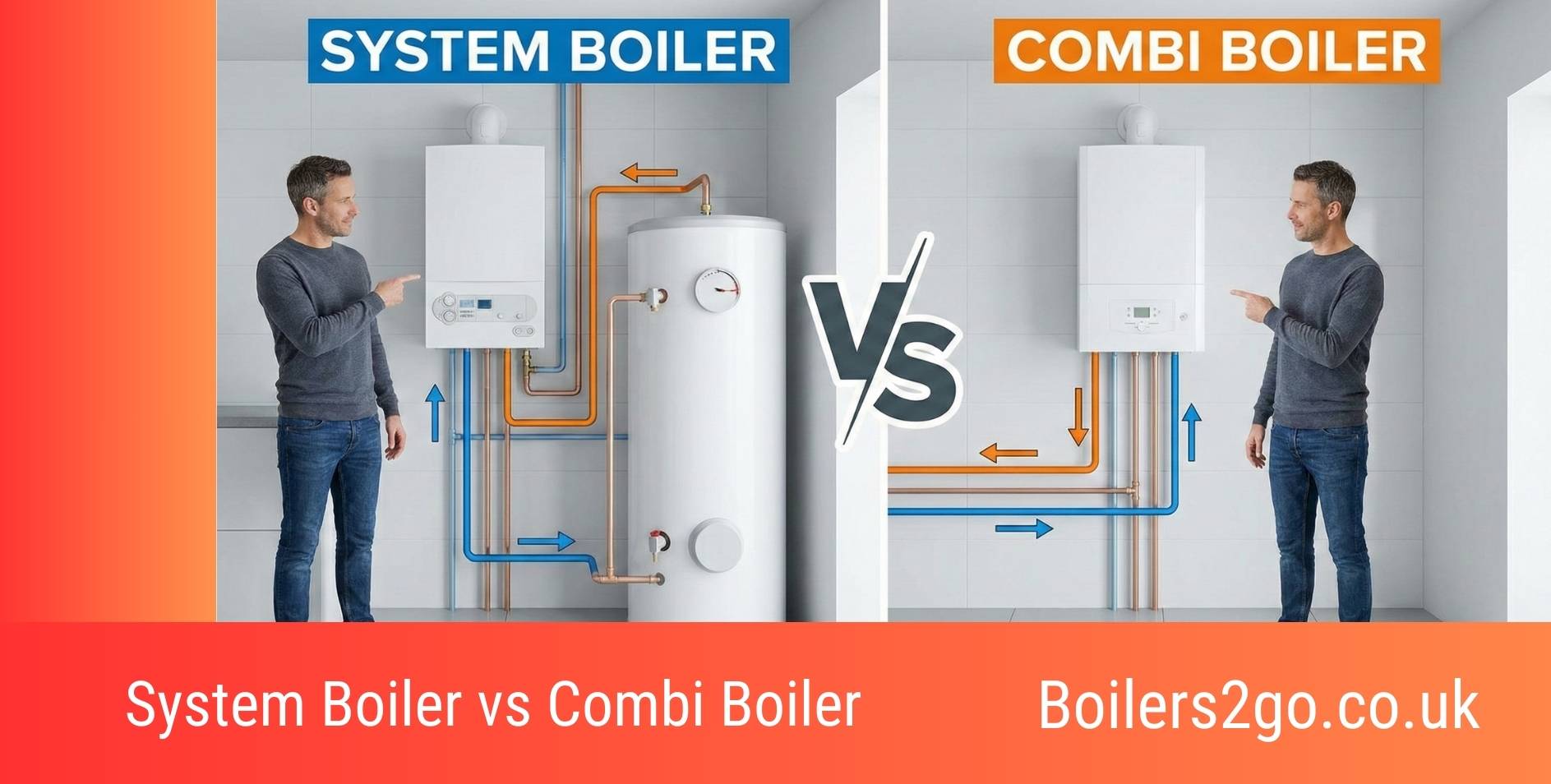
Choosing between a system boiler and a combi boiler shapes hot water flow, running costs and the space needed in a property for years to come. This guide compares both boiler types across efficiency, cost, upkeep and suitability.
A poor match between boiler type and household size is one of the more expensive heating mistakes UK homeowners make. The right choice depends on bathroom count, hot water demand and available space, not budget alone.
System Boiler vs Combi Boiler: A Quick Comparison
The table below sets out the main differences between these two popular central heating systems at a glance.
| Aspect | Combi Boiler | System Boiler |
|---|---|---|
| How It Works | Heats water on demand directly from the mains, no need for storage tanks. | Uses a separate hot water cylinder to store preheated water, fed directly from the mains. |
| Space Requirements | Compact, wall-mounted unit; ideal for small spaces. | Requires space for a hot water cylinder, but no loft tanks. |
| Hot Water Supply | Instant hot water, but limited to one outlet at a time. | Provides hot water to multiple outlets simultaneously without pressure drop. |
| Efficiency | High efficiency (up to 94% in A-rated 2026 models), especially for low-demand homes. | Similarly efficient, though slight heat loss from the cylinder; well-insulated cylinders close the gap. |
| Installation Cost | Typically £1,800 – £3,200 including fitting. | Typically £2,500 – £4,500 including fitting and cylinder. |
| Suitability | Best for small to medium homes with 1-2 bathrooms. | Ideal for larger homes with 2+ bathrooms and high hot water needs. |
| Maintenance | Simpler, fewer parts; annual servicing recommended. | More components mean potentially higher servicing costs. |
Combi Boilers
A combi boiler, short for combination boiler, heats water directly from the mains the moment a tap or radiator is switched on. There is no storage tank involved.
This makes combi boilers a common choice in UK flats and smaller homes where cupboard space is limited.
Anyone comparing models should read our guide to the best combi boilers, weighing up reliability, warranty length and customer support before choosing one.
By heating water only when it’s needed, a combi avoids the standing losses that come with storing hot water in a cylinder. Our guide to how a combi boiler works explains the process in more detail.
Pros include a compact footprint, strong efficiency (many 2026 A-rated models reach 90-94% under the ErP scheme), a lower upfront installation cost, and hot water on demand without waiting for a tank to refill.
Cons include pressure drops when two outlets run at once, a shower and a kitchen tap for example, which can frustrate busy households. Hard water areas without a scale filter can see limescale build up inside the heat exchanger, pushing up repair bills over time.
System Boilers
A system boiler takes water directly from the mains and heats a separate hot water cylinder, where hot water is stored ready for use. Central heating is handled separately by the boiler itself.
This setup performs well in larger homes needing strong, simultaneous hot water flow, including older properties with two or more bathrooms.
Pros include reliable performance across multiple bathrooms, steady pressure even when a bath and shower run together, and straightforward compatibility with solar thermal panels for households working towards lower carbon heating.
Cons include the extra space needed for the cylinder, typically an airing cupboard or utility room. Some heat is lost from the cylinder over time, and installation takes longer than a straightforward combi swap. Landlords also need to budget for cylinder maintenance between tenancies.
System Boiler vs Combi Boiler: Key Differences
The real differences between these two systems come down to how hot water is handled, the space required, and long-term running costs.
System vs Combi Boiler Efficiency
Both system and combi boilers can reach over 90% efficiency in 2026’s condensing models, but combis edge ahead for on-demand heating without storage losses. In smaller households, this can trim 15-20% off water heating costs by avoiding standby heat waste.
System boilers remain efficient overall, though even a well-insulated cylinder loses a small amount of heat between uses. For landlords, combi boilers often help improve EPC ratings in smaller rental properties, though system boilers stay the more reliable option where hot water demand is high.
Here’s a quick table to compare efficiency aspects:
| Aspect | Combi Boiler | System Boiler |
|---|---|---|
| Typical Efficiency Rating (2026 models) | Up to 94% (A-rated ErP) | Up to 92-93% (slight loss from cylinder) |
| Heat Loss | Minimal, no storage tank | 1-2% possible from hot water cylinder |
| Best For | Low-demand homes, maximising bill savings | Larger homes with well-insulated cylinders |
| EPC Impact | Often boosts ratings in smaller properties | Reliable for high-demand rentals |
System vs Combi Boiler Costs
Combi boiler installation in 2026 typically costs £1,800 to £3,200, with straightforward like-for-like swaps often landing nearer £2,000 to £2,800. A system boiler installation, including a new hot water cylinder, usually runs £2,500 to £4,500, reflecting the extra parts and labour involved.
Ongoing servicing tends to cost £100 to £150 a year for a combi boiler, while a system boiler runs £150 to £250 once the cylinder and any pumps are checked.
Homeowners in budget-conscious areas often favour a combi’s lower entry point, whereas landlords tend to view a system boiler’s higher upfront cost as an investment in tenant satisfaction and fewer callouts.
A cost breakdown (approximate 2026 UK averages):
| Cost Type | Combi Boiler | System Boiler |
|---|---|---|
| Purchase & Installation | £1,800 – £3,200 | £2,500 – £4,500 (includes cylinder) |
| Annual Servicing | £100 – £150 | £150 – £250 (cylinder checks extra) |
| Potential Repair Costs | Lower (fewer components) | Higher if cylinder or pump fails |
| Long-Term Savings | Better for small households | Better for high usage (consistent pressure) |
System vs Combi Boiler Maintenance and Servicing
Servicing a combi boiler mainly involves checking the heat exchanger and system pressure, a job that’s usually quick and straightforward. A system boiler needs the added step of inspecting the cylinder for scale or leaks, which can add roughly £50 to the annual bill.
Combi boilers suit busy households wanting minimal hassle. System boilers, by contrast, allow individual parts to be replaced without shutting down the whole system, which landlords often find useful for minimising void periods between tenants.
| Aspect | Combi Boiler | System Boiler |
|---|---|---|
| Typical Annual Service | Basic checks (heat exchanger, pressure) | Full system and cylinder inspection |
| Service Time | 1-2 hours | 2-3 hours |
| Annual Cost | £100 – £150 | £150 – £250 |
| Common Issues | Limescale in heat exchanger | Cylinder scale, pump wear |
| Downtime During Repairs | Often the whole system is off | Parts can be isolated for minimal disruption |
System vs Combi Boiler Suitability by Property Type
Combi boilers thrive in compact flats and bungalows with low hot water demand, while system boilers excel in family houses and multi-occupancy rentals needing simultaneous supply. They handle higher flow rates without faltering, which suits larger UK properties well.
A practical guide to matching boiler type to property size:
| Property Size | Bathrooms | Hot Water Demand | Recommended Boiler | Why? |
|---|---|---|---|---|
| Studio / 1 Bed Flat | 1 | Low (1-2 people) | Combi | Compact, instant hot water, cost-effective |
| 2 Bed House/Flat | 1-2 | Moderate (2-4 people) | Combi (or System if high demand) | Combi usually sufficient |
| 3 Bed House | 2 | Medium-High (family) | Combi or System | System better for simultaneous use |
| 4+ Bed House | 2-3+ | High (large family) | System | Strong pressure, no drop at peak times |
| Multi-occupancy / HMO | 2+ | Very High (shared) | System | Reliable supply, fewer tenant complaints |
System vs Combi Boiler Installation Requirements
Installing a combi boiler is usually straightforward. A Gas Safe registered engineer fits the unit with minimal pipework, often within a single day.
A system boiler demands more space for the cylinder, which can extend the job to two or three days and must meet Building Regulations Part G. Part G covers safe hot water storage, including the discharge pipework on unvented cylinders, and our guide explains what a tundish is and where it fits in.
Many current models of both types are hydrogen-blend ready (up to 20%), and system boilers tend to integrate easily with an existing hot water cylinder in older properties.
System Boiler or Combi Boiler: Which One Should You Choose?
Choosing between a system or combi boiler comes down to household size, hot water needs and available space. If neither seems quite right, our guide to the main types of boilers also covers regular and storage combi options.
Choose a combi boiler if the property is small to medium sized with one or two bathrooms, space-saving design matters, and instant hot water without storage tanks is the priority. It suits flats and young couples prioritising efficiency and lower bills.
A combi boiler is not the best fit where a property has high simultaneous demand, such as multiple showers running at once, or where hard water isn’t managed with a filter, since this can lead to frequent breakdowns. Our guide to combi boiler pros and cons helps weigh these against a household’s actual usage patterns, and regular maintenance keeps a combi running efficiently for longer.
Choose a system boiler if the home is larger with two or more bathrooms, consistent pressure for family use matters, or solar thermal integration is planned. Landlords often prefer system boilers for the reliable tenant satisfaction they provide in bigger rentals.
A system boiler is not the best fit where space is tight, budget for installation is limited, or hot water needs are minimal, since the extra components can be more than the property actually requires.
Ready to Install a New Boiler? Get Expert Advice
Deciding between a system and combi boiler is easier with a professional assessment of a property’s layout, bathroom count and hot water demand. A Gas Safe registered engineer can confirm which system suits a home best and provide a written quote before any work begins.
For guidance on choosing a qualified installer, the Gas Safe Register allows anyone to check an engineer’s registration number before booking work, an important step for both homeowners and landlords.
Requesting quotes for both boiler types from Gas Safe registered engineers allows for a direct cost comparison before deciding, particularly where a property sits on the boundary between combi and system suitability.
System Boiler vs Combi Boiler: FAQs
How Does Water Pressure Affect the Choice Between System and Combi Boilers?
In areas with low incoming mains pressure, a system boiler often performs better, since the cylinder is fed by gravity or a pump rather than relying solely on mains flow. A combi boiler depends directly on mains pressure, and where this is weak, an additional pump may be needed to maintain a decent shower experience.
Homes on older mains supplies, or those at the end of a long distribution pipe, are worth testing for pressure before a boiler type is chosen.
Can System and Combi Boilers Work With Underfloor Heating?
Yes, both system and combi boilers can work with underfloor heating, though system boilers tend to provide more consistent low-temperature output across larger installations.
This makes system boilers a common choice for extensive underfloor heating in new-build UK properties, while combi boilers suit smaller single-room retrofits well.
Which Is Better for the Environment, a System or Combi Boiler?
Combi boilers typically have a slightly smaller carbon footprint since there are no storage losses from a cylinder. However, the gap has narrowed as manufacturers roll out hydrogen-blend ready systems and better cylinder insulation.
Households considering heat pump compatibility for the future should note that system boilers, with their existing cylinder, can sometimes ease a later switch to a hybrid heating setup.
How Does Warranty Cover Vary for System and Combi Boilers?
Most manufacturers offer warranties ranging from two years on budget models to as long as twelve years on premium boilers, provided installation is carried out by an approved engineer.
System boilers may also need separate cylinder warranty cover, which is worth checking at the point of purchase, particularly for landlords wanting long-term peace of mind.
Are Combi Boilers Quieter Than System Boilers?
Combi boilers are generally quieter in daily use, since they don’t need a cylinder pump running. This suits open-plan living spaces where the boiler sits close to living areas.
System boilers can produce a subtle hum from circulation components, though modern models have reduced this considerably compared with older units.
Can You Convert a System Boiler to a Combi Boiler, or Vice Versa?
Yes, conversions are possible in both directions, though they add cost and time compared with a like-for-like swap. Moving from a system to a combi usually means removing the cylinder and any tank, while converting to a system boiler involves fitting a cylinder and finding space for it.
A Gas Safe registered engineer can assess whether the existing pipework and gas supply can support the change.
Which boiler type suits a rental property or HMO best?
System boilers are often the more practical choice for houses in multiple occupation and larger rentals, since they can supply several bathrooms at once without a drop in pressure. This reduces tenant complaints about hot water and can make a property easier to let.
Landlords with smaller, single-occupancy rentals may still find a combi boiler perfectly adequate and cheaper to maintain.
Do System or Combi Boilers Work Better With Solar Thermal or a Heat Pump?
System boilers integrate more easily with solar thermal panels, since the cylinder can store water heated by the sun before the boiler tops up any shortfall.
Combi boilers are less compatible with solar thermal for this reason, though hybrid setups pairing a combi with a heat pump are becoming more common as households look to reduce reliance on gas.

I’m Penny North, a home energy heating expert. My mission is to demystify new boilers and complex heating systems to help you achieve a warm, cosy home with lower energy bills and a smaller environmental footprint.