

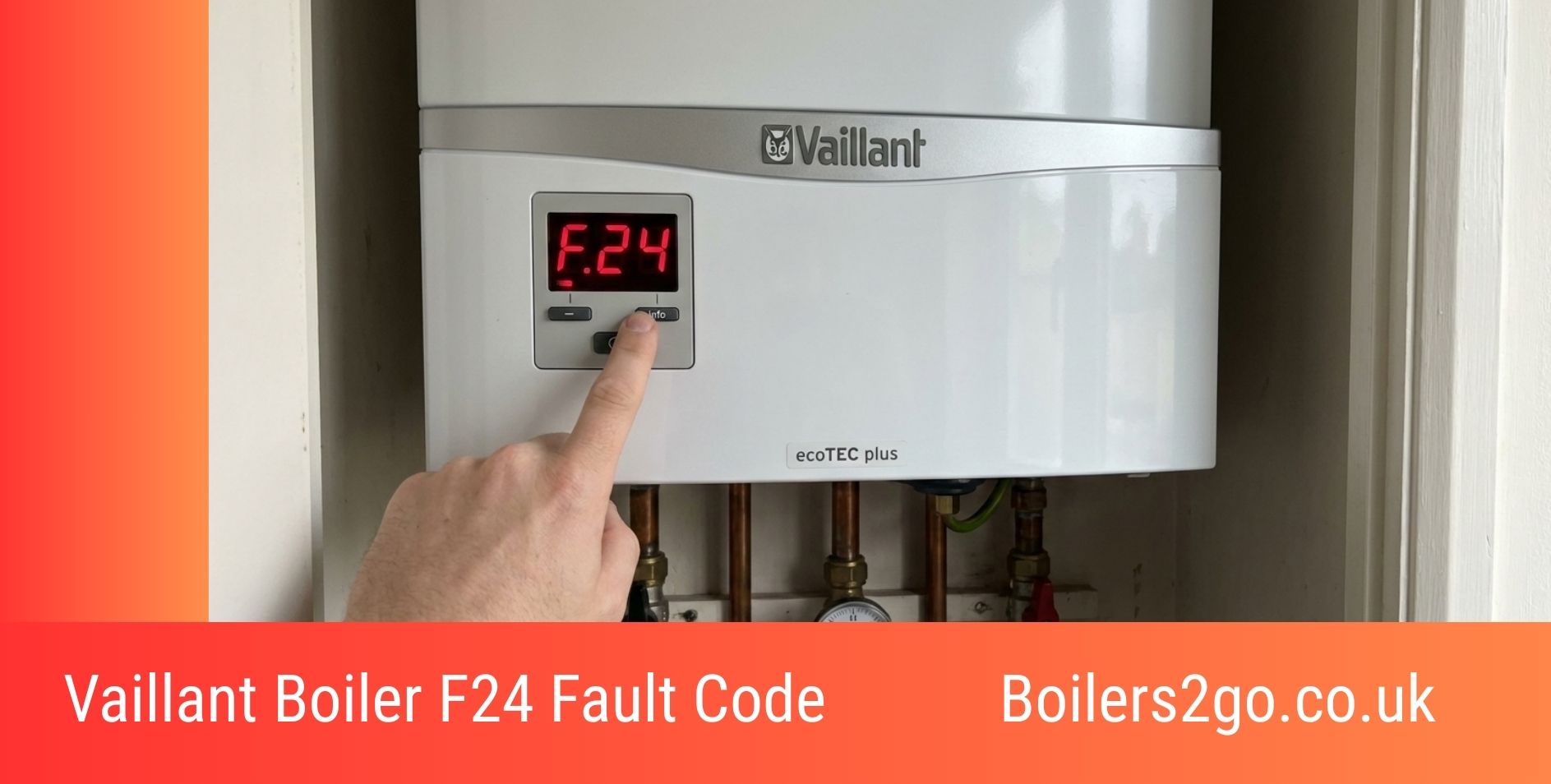
Seeing the Vaillant boiler F24 fault code appear on your boiler display can be worrying, especially during the cold UK winter months when you rely on your heating and hot water the most.
This common error on Vaillant ecoTEC Plus, ecoTEC Pro, and older models points to a specific problem with water circulation inside the boiler.
The good news is that while some causes are simple and can be checked by a homeowner or landlord, most F24 faults require a Gas Safe registered engineer to fix safely.
What Does the Vaillant F24 Fault Code Mean?
The Vaillant F24 fault code means the boiler has detected that the water temperature is rising too quickly or has overheated because the water is not circulating properly around the system. This issue could stem from a blockage in the pipes, a malfunctioning pump, or air trapped in the system, preventing water from flowing smoothly. To resolve the problem, it’s essential to diagnose the underlying cause and, if necessary, consult a professional technician. For further understanding, you can refer to the ‘vaillant boiler f4 error explanation‘ to uncover additional insights about common issues and troubleshooting steps. It’s also helpful to familiarize yourself with the vaillant boiler radiator symbol meaning, as it can indicate issues related to heating efficiency or flow problems. Addressing these symbols promptly can prevent further complications and ensure optimal performance of the boiler system. Regular maintenance and monitoring of your boiler can significantly reduce the likelihood of encountering fault codes like F24.
In simple terms, the pump is trying to move water, but something is stopping it from flowing correctly, so the heat builds up in the heat exchanger and the boiler locks out to protect itself.
This is a safety feature – without it, the boiler could overheat and cause serious damage or become dangerous.
What Causes the Vaillant F24 Fault Code?
There are several proven causes of the F24 error on Vaillant boilers. Below are the most common ones we see in the UK, along with exactly how to diagnose and fix each one. In addition to the F24 error, it’s important to be aware of the Vaillant boiler F54 fault code, which may indicate issues related to the heating circuit or flow temperature sensor. By understanding these error codes, homeowners can better diagnose and address problems, ensuring their heating system operates efficiently. Regular maintenance and timely repairs will help prevent these errors from recurring in the future. Another important error to consider is the vaillant boiler fault code f84, which typically signifies issues with the boiler’s ignition or flame detection system. Homeowners experiencing this fault should also consult a certified technician to ensure safe and effective repairs. Staying informed about various fault codes not only aids in quick troubleshooting but also enhances the longevity and reliability of the heating system.
1. Is the Boiler or System Pressure Too Low?
Low system pressure is the number one cause of an F24 fault on Vaillant boilers.
How to check: Look at the pressure gauge on the front of your boiler (usually a black needle or digital display). It should sit between 1 and 1.5 bar when the system is cold. If it’s below 0.8–1 bar, this is almost certainly your problem.
How to fix it yourself (safe for homeowners/landlords):
- Locate the filling loop (usually a silver flexible hose or two taps/valves under the boiler).
- Slowly open the valves to let water in until the pressure reaches 1–1.5 bar.
- Close the valves tightly.
- Press the reset button on the boiler (usually marked with a flame or reset symbol) for 3–5 seconds.
- If the F24 clears and the heating works, you’re sorted.
Note: If the pressure keeps dropping again within days or weeks, you have a leak somewhere – call a Gas Safe engineer.
2. Is the Pump Stuck, Seized, or Faulty?
The circulation pump pushes hot water around your radiators and back to the boiler. If it fails or gets stuck (common after summer when the boiler has been off for months), you’ll get an F24.
How to check: You may hear no pump noise at all, or a loud humming/grinding from inside the boiler.
How to fix it:
- Try gently tapping the pump body (front centre of most Vaillant ecoTEC models) with a screwdriver handle – sometimes this frees a stuck impeller.
- If that doesn’t work, the pump has failed or the capacitor has died. This requires a Gas Safe engineer to replace the pump (cost usually £250–£450 inc labour and VAT).
3. Is There Air in the System or Pump?
Air locks stop the pump from moving water properly and trigger the F24.
How to fix it yourself:
- Bleed all radiators starting downstairs and working upwards.
- Bleed the pump itself – most Vaillant ecoTEC boilers have a large chrome screw in the middle of the pump. Place a cloth underneath, unscrew a couple of turns with a screwdriver until water (and air) hisses out, then tighten again.
- Repressurise the system and reset the boiler.
4. Is the Plate Heat Exchanger Blocked or Scaled?
In hard-water areas (most of the South East, Midlands, and parts of the South West), limescale builds up inside the secondary plate heat exchanger and restricts flow.
How to check: The hot water may be lukewarm even when the heating works, and the boiler may make kettle-like noises.
How to fix it: This needs a professional powerflush or chemical descale and sometimes a new plate heat exchanger (£400–£700 job).
5. Is There a Blockage in the System or a Closed Valve?
A closed motorised valve, blocked filter, or sludge in the pipes can all restrict flow.
How to check: Check that both valves directly underneath the boiler (flow and return) are fully open (handles in line with the pipe). Also check any zone valves are opening.
How to fix it: Open any closed valves. A full system powerflush (£350–£600) is usually required if sludge is the culprit.
How to Prevent the Vaillant F24 Fault Code in the Future
- Have your boiler serviced every 12 months by a Gas Safe engineer – this catches pump issues, scale build-up, and low pressure early.
- Keep system pressure checked monthly (takes 10 seconds).
- Fit a magnetic system filter (e.g. MagnaClean or Fernox TF1) if you don’t already have one – they trap sludge and stop blockages.
- In hard-water areas, install a scale reducer or water softener.
- Bleed radiators once a year before winter.
When You Absolutely MUST Call a Gas Safe Engineer
You must call a Gas Safe registered engineer immediately if:
- You’ve repressurised and the fault comes straight back.
- You can’t find or use the filling loop safely.
- You hear no pump noise or strange grinding.
- You smell gas at any point.
- The boiler is leaking water.
- You’re a landlord – you have a legal duty under the Gas Safety (Installation and Use) Regulations 1998 to use a qualified engineer.
DIY beyond checking pressure and bleeding radiators can be dangerous and will invalidate your warranty.
FAQs
Will my Vaillant warranty cover an F24 fault?
Most Vaillant boilers come with 5–10 year warranties. Pump failure and scale-related blockages are usually covered (parts only) as long as the boiler has been serviced annually by a Gas Safe engineer. You’ll still pay labour and call-out.
Can the F24 fault damage my boiler if I keep resetting it?
Yes. Repeatedly resetting without fixing the circulation problem causes repeated overheating of the heat exchanger, which can lead to cracks and expensive repairs (£800+).
Is the F24 the same on all Vaillant models?
Yes – it has the same meaning on ecoTEC Plus, Pro, older TurboMax, Ecomax, and even some Glow-worm models (Vaillant owns Glow-worm).
My boiler shows F24 and then F28 or F29 after reset – what does that mean?
This usually means the pump is completely seized or the PCB can’t power the pump. It needs an engineer urgently.
How much does it typically cost to fix an F24 fault in the UK (2025 prices)?
- Low pressure top-up (if no leak): Free if you do it yourself, £80–£120 engineer call-out.
- New pump: £300–£450.
- Powerflush + scale reducer: £500–£800.
- New plate heat exchanger: £550–£750.

I’m Penny North, a home energy heating expert. My mission is to demystify new boilers and complex heating systems to help you achieve a warm, cosy home with lower energy bills and a smaller environmental footprint.