

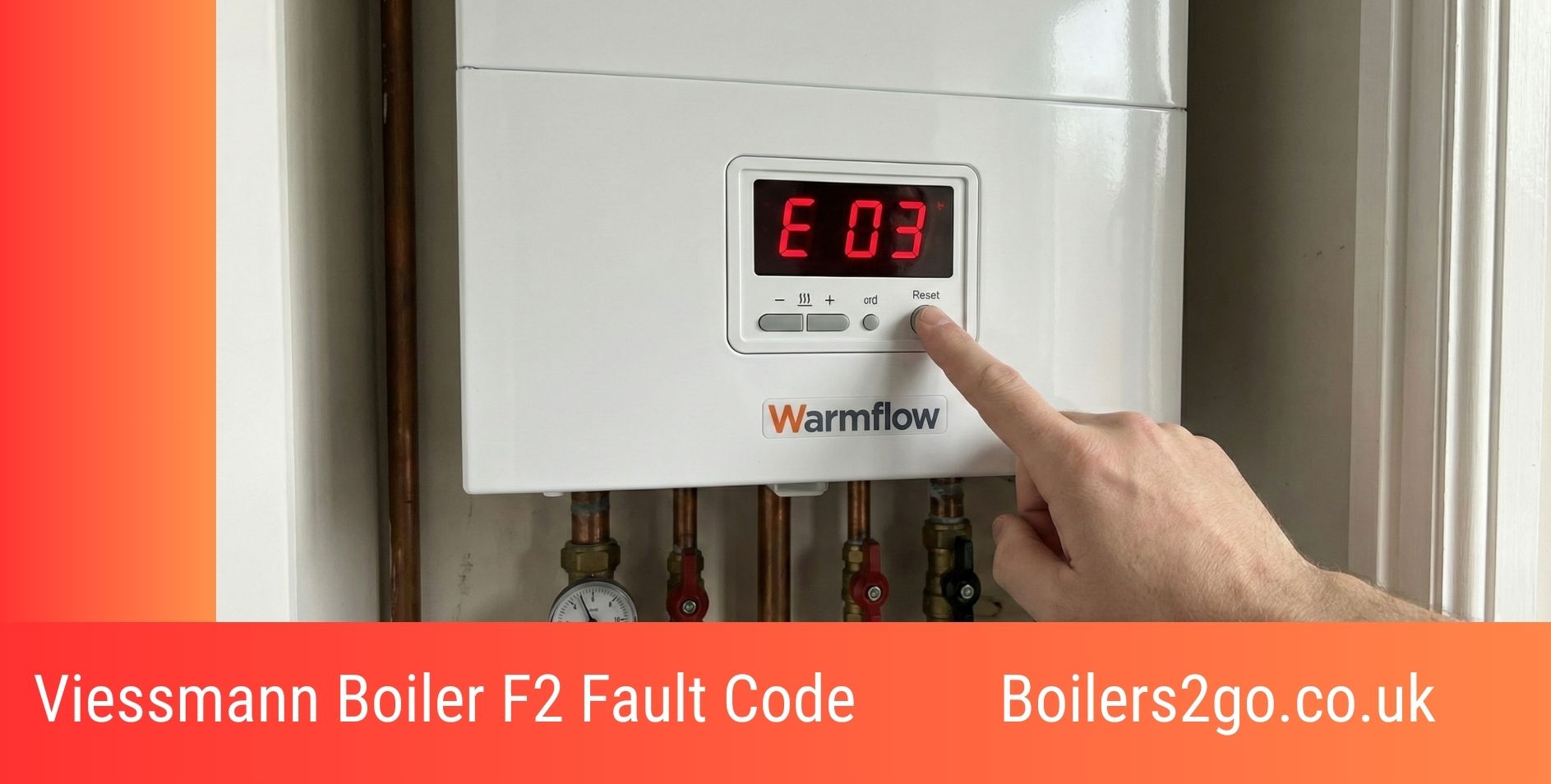
The Viessmann boiler F2 fault code on your Vitodens combi or system boiler can bring your central heating and hot water to a sudden halt, leaving UK households feeling the chill.
In this guide, I’ll explain what the F2 error code means, discuss its common triggers with real-world insights, and provide clear, actionable steps to diagnose and resolve it while prioritising safety and efficiency.
What Does the Viessmann Boiler F2 Fault Code Mean?
The Viessmann boiler F2 fault code means the burner has locked out due to an ignition failure or flame detection issue, preventing the boiler from producing heat for radiators or taps. Common issues with Viessmann boilers can often lead to the F2 fault code, including problems with the gas supply, faulty ignition components, or a malfunctioning flame sensor. Addressing these issues promptly is essential to restore the boiler’s functionality. Regular maintenance and inspections can help prevent future occurrences of such faults. Additionally, if the F2 fault persists, it may be necessary to consult a professional technician for a thorough diagnosis and repair. Understanding the related issues, such as the Viessmann boiler F5 fault code overview, can also provide insights into other potential complications that may arise. Keeping detailed records of any fault codes and maintenance performed can aid in quicker resolutions in the future. Additionally, understanding the Viessmann boiler F1 fault code explanation can further enhance your ability to troubleshoot related issues, as it often indicates a fault in communication or control systems. Being aware of these fault codes allows for quicker identification of problems and can lead to more efficient resolutions. It is advisable to stay informed about all potential fault codes to ensure optimal boiler performance year-round.
In simple terms, the boiler attempts to light its burner, the component that mixes gas and air to create the flame for heating water, but senses something unsafe, like no flame forming or losing it shortly after ignition, so it halts everything to protect your home from potential carbon monoxide exposure or component damage.
This code is widespread on Viessmann Vitodens models (e.g., 050-W, 100-W, 200-W), favoured in UK properties from suburban semis in the Midlands to rental homes in Scotland, where reliable condensing boiler performance is key for energy savings and compliance with building regs.
Symptoms include no heat output, a flashing F2 on the display, and sometimes an audible click from failed ignition attempts – but unlike low-pressure faults, F2 demands prompt attention to avoid escalation.
What Causes the Viessmann Boiler F2 Fault Code?
The F2 lockout stems from disruptions in the ignition or flame-sensing process, often linked to fuel delivery, sensor accuracy, or blockages that the printed circuit board (PCB) interprets as hazards. From Gas Safe engineer insights across the UK, these causes frequently arise in everyday scenarios, such as unserviced systems in hard-water areas or seasonal issues in exposed installations – here’s each one unpacked with context for your home heating troubleshooting.
Cause 1: Insufficient or Interrupted Gas Supply
Gas boilers rely on a steady mains pressure (around 21 mbar for natural gas) to feed the burner; dips below this from a partially closed isolation valve, empty prepay meter, or supplier disruptions. The ignition stops entirely, triggering F2 as the PCB detects no flame formation.
This is a top culprit in urban rentals where meters run low unnoticed or during peak winter demand spikes.
How to Fix Insufficient Gas Supply Causing F2
- Meter and Valve Check: Locate your gas meter (often in a cupboard or outside) and ensure the emergency control valve is fully open (handle parallel to the pipe); top up a prepay meter via your app or card if it’s low – this DIY step clears F2 in 20–30% of cases.
- Appliance Test: Light a hob or cooker to confirm flow; weak flames signal low pressure, so call your supplier (e.g., British Gas emergency line) for a free check.
- Professional Adjustment: A Gas Safe engineer uses a manometer to measure and tweak pressure at the boiler inlet (to 18–25 mbar), costing £80–£150, ensuring safe combustion without over-fuelling.
Cause 2: Faulty Ignition Electrode or Flame Sensor
The ignition electrode sparks to light the gas, while the flame sensor (ionisation probe) detects the resulting flame via electrical current; dirt, misalignment, or wear (from soot in unserviced burners) causes misfires or false no-flame signals, locking out with F2. Common in boilers over 5 years in dusty lofts or kitchens, where annual servicing gaps allow buildup.
How to Fix Faulty Ignition Electrode or Flame Sensor Causing F2
- Visual Inspection Prep: Power off at the fused spur and let cool; an engineer removes the burner cover to check for carbon deposits or cracks – clean gently with fine emery paper if minor, avoiding abrasives that scratch ceramics.
- Realignment and Gap Check: Adjust electrode tips to 3–4 mm from the burner ports using the Vitodens manual diagram; test spark continuity with a multimeter (should arc consistently).
- Replacement: Swap worn parts (£40–£80 each for Viessmann OEM); full job takes 45–90 minutes (£150–£250 total), followed by a combustion test to confirm CO levels under 0.002%.
Cause 3: Blocked Burner or Heat Exchanger
Debris, limescale, or soot clogs the burner jets or stainless steel heat exchanger, restricting gas-air mix for stable ignition and causing flame instability that trips F2. This builds up in hard-water zones like the South East or neglected rentals, where sludge from radiators circulates back, reducing efficiency by up to 15% before lockout.
How to Fix Blocked Burner or Heat Exchanger Causing F2
- Initial Flush Attempt: If accessible, an engineer performs a quick descale on the sump with citric acid solution, but for full blockages, isolate water and use a chemical cleaner circulated via pump (£100–£200).
- Deep Clean: Dismantle the burner assembly for jet brushing and exchanger power flushing with a specialist rig, removing years of scale – essential for condensing models to restore A-rated ErP efficiency.
- Preventive Filter: Install a magnetic in-line filter (£100–£150 fitted) post-repair to trap debris, with annual inhibitor dosing to inhibit corrosion in your central heating pipes.
Cause 4: Frozen or Blocked Condensate Pipe
In UK winters, the external plastic condensate pipe (draining acidic waste water) freezes solid or clogs with sludge, backing up pressure and disrupting burner operation, leading to F2 as the system senses unsafe conditions. Prevalent in exposed northern installations or uninsulated rentals, where sub-zero temps hit pipes running along outer walls.
How to Fix Frozen or Blocked Condensate Pipe Causing F2
- Thaw Method: Pour lukewarm (not boiling) tap water over the visible pipe section from a safe height using a jug, working from outlet inwards until flow resumes – insulate immediately with foam lagging (£10 from DIY stores).
- Internal Clear: Engineer accesses the siphon trap inside the boiler, flushing with vinegar solution to dissolve blockages; check for kinks in the 22mm pipe run.
- Upgrade Protection: Reroute to a warmer drain or add electric trace heating (£150–£300) for chronic issues, ensuring no acidic leaks damage brickwork per building regs.
Cause 5: Circulation Pump Failure or Airlocks
A seized pump (circulating hot water) or air bubbles trapped in pipes reduce flow, overheating the exchanger and causing flame rollout or loss that activates F2 lockout. Typical in older Vitodens units after inactivity (e.g., summer holidays) or sludge-heavy systems, straining the Grundfos/Wilo pump over time.
How to Fix Circulation Pump Failure or Airlocks Causing F2
- Bleed and Top-Up: Start DIY by bleeding radiators (lowest floor first) with a key until water spits, then repressurise via filling loop to 1.2–1.5 bar – this purges air in 25% of mild cases.
- Pump Diagnostics: Engineer listens for hum (no sound = seized); free the shaft manually or replace the head (£180–£280 for compatible models), testing speed settings (I/II/III).
- System Flush: Follow with a power flush (£300–£500) to clear sludge, balancing radiators for even flow and preventing recurring overheat in your heating circuit.
How to Reset a Viessmann Boiler After Clearing F2
Post-fix:
- Verify gas flow, pressure at 1–1.5 bar, and no blockages.
- Press the reset button (R symbol on the fascia) for 3 seconds until the display confirms.
- Monitor a full cycle (15 minutes) for stable flame; repeated F2 needs engineer recall. Safety first – never force resets without addressing causes to avoid PCB damage.
FAQs
How does unserviced boiler age accelerate F2 lockouts?
Viessmann boilers over 7 years without annual checks see F2 up to 35% more due to gradual electrode wear and sludge accumulation, per Gas Safe stats – budgeting £80–£120 yearly prevents this.
Can smart thermostats like Nest indirectly trigger F2?
Incompatible zoning from non-OpenTherm devices causes erratic burner demands, mimicking ignition failures; Viessmann Vitosoft integration avoids this for smoother modulation.
What’s the energy impact of ignoring F2 until lockout?
Pre-lockout inefficiency from poor ignition hikes gas use by 8–12%, straining your EPC rating – early fixes restore condensing efficiency for lower winter bills.
Do regional gas variations affect F2 frequency in the UK?
Converted LPG setups in rural areas show F2 20% more from pressure inconsistencies; engineers adjust regulators specifically for bottled gas stability.
How does F2 relate to other codes like F5 on Vitodens?
F2 focuses on burner ignition loss, while F5 signals overheat from sustained attempts; both often chain from the same circulation woes but require sequenced diagnostics.

I’m Penny North, a home energy heating expert. My mission is to demystify new boilers and complex heating systems to help you achieve a warm, cosy home with lower energy bills and a smaller environmental footprint.