

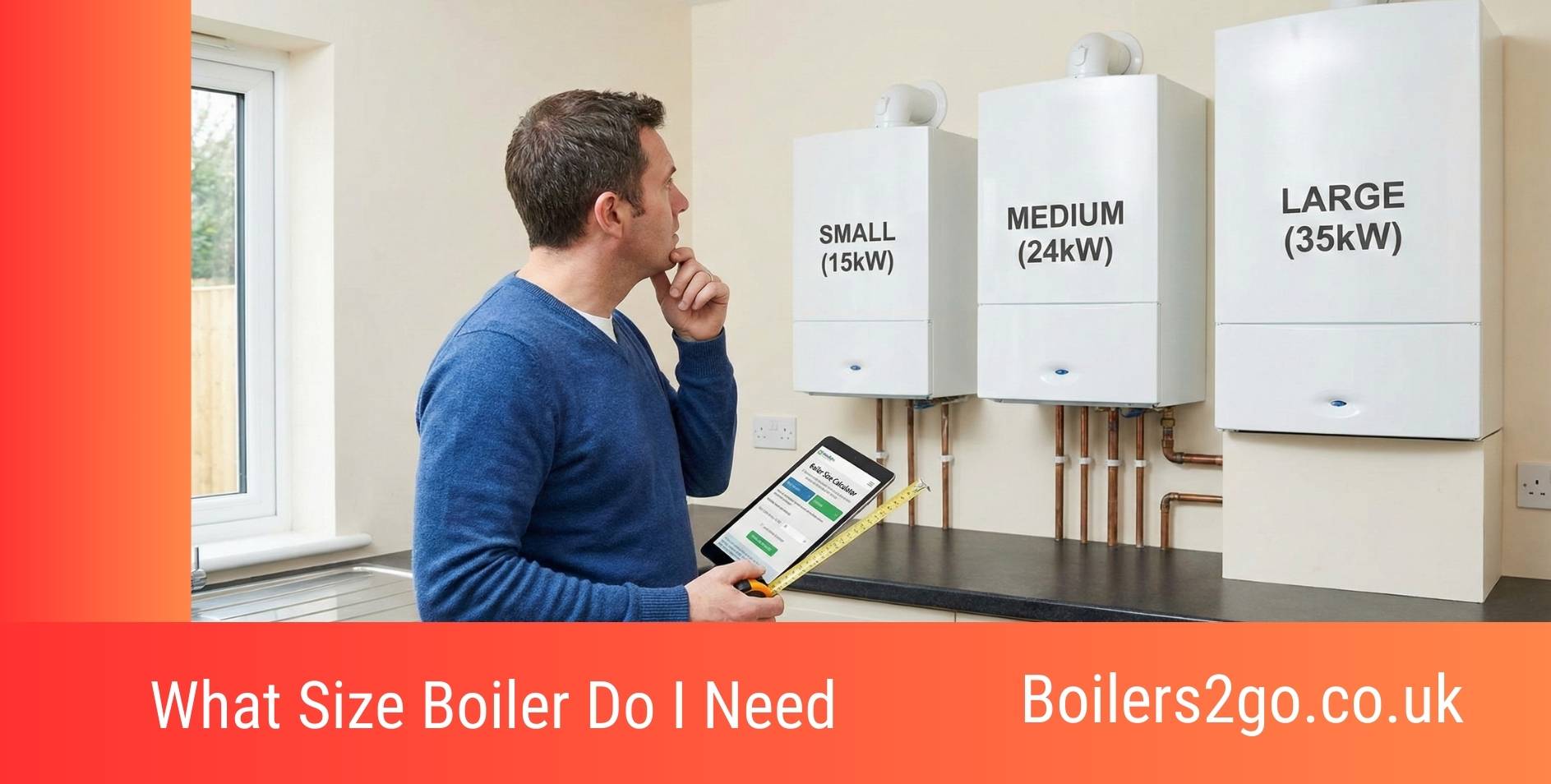
Working out what size boiler a home needs starts with understanding property size, bathroom count, and boiler type. Combi, system and regular boilers are sized quite differently even for the same property, so our guide to the main types of boilers is a useful first step.
This guide covers recommendations for different UK property sizes, bathroom counts, and boiler types, so the right kW output can be matched to the right home.
How Do You Work Out What Size Boiler You Need?
Working out the right size starts by assessing property size, number of bedrooms, bathrooms, radiators, and hot water usage, then matching them to kW output recommendations.
Assessing the layout of the space and any obstacles that might affect installation helps avoid surprises later. Sizing and fitting should be left to a Gas Safe registered engineer, who will also make sure the installation meets regulations, including ventilation requirements.
Sizing isn’t just about square footage. UK insulation levels and household habits play a significant role too, which is why two similarly sized homes can need noticeably different boiler outputs.
Key Considerations for Boiler Sizing
Start with the home’s layout: smaller properties need less power, while larger ones with multiple bathrooms require higher kW for simultaneous showers without pressure drops.
What Factors Affect the Boiler Size for UK Properties?
Factors that affect boiler size for UK properties include the number of radiators, insulation quality, boiler type, and hot water needs based on bathrooms and occupants.
Overlooking insulation in older UK homes often leaves an undersized boiler struggling in winter, while over-sizing wastes energy, something landlords in particular can’t afford with rising tariffs.
Boiler Types and Their Sizing Differences
Combi boilers, popular for space-saving, combine heating and hot water, needing higher kW for demand. System and regular (heat-only) boilers pair with cylinders, focusing lower kW on space heating since hot water is stored separately. Whichever type is chosen, a high-efficiency model only delivers real savings when it is correctly sized. If you are not sure which one is fitted now, our guide on what type of boiler you have explains how to check.
What Size Combi Boiler Do I Need for My Home?
Combi boiler size depends on bedrooms, bathrooms, and radiators, typically ranging from 24 to 42 kW for UK properties.
A combi generally suits smaller to medium homes where instant hot water fits busy lifestyles, though flow rates for multiple taps are worth checking before committing to a specific output. Here’s a table for combi recommendations:
| Number of Bathrooms | Number of Radiators | Number of Bedrooms | Recommended Combi Boiler Size (kW) |
|---|---|---|---|
| 1 | 0-10 | 1-2 | 24-27 |
| 2-3 | 10+ | 3-4 | 28-34 |
| 3+ | 20+ | 4+ | 35-42 |
This table accounts for hot water flow. A 3-bedroom semi with two bathrooms, for example, might need around 30 kW to handle showers without lag.
Adjustments for Multiple Bathrooms
In homes with two or more bathrooms, it’s worth allowing 5 to 10% more kW if simultaneous use is common, such as family mornings or landlord-managed HMOs.
What Size System or Regular Boiler Is Right for My Property?
System or regular boiler size focuses on heating output, generally 10 to 30 kW, and suits larger UK homes with stored hot water via cylinders. These shine in properties with high demand, such as rural rental properties where combis can struggle on low mains pressure.
| Number of Bathrooms | Number of Radiators | Number of Bedrooms | Recommended System/Regular Boiler Size (kW) |
|---|---|---|---|
| 1 | 0-10 | 1-2 | 10-15 |
| 2-3 | 10+ | 3-4 | 15-20 |
| 3+ | 20+ | 4+ | 20-30 |
These lower kW ratings suit the setup because hot water is pre-heated in the cylinder, reducing the peak load the boiler itself has to meet.
What Size Boiler Do I Need for a Small 1-2 Bedroom Home?
A small 1-2 bedroom home typically needs 24 to 27 kW for a combi or 10 to 15 kW for a system or regular boiler, scaling with bathrooms. Our guide to the best boilers for a 2 bedroom house recommends specific models at this size.
In compact UK flats or bungalows, over-sizing tends to lead to short-cycling and inefficiency, so it’s better to match output closely for lower bills. For one bathroom, 24 to 27 kW combi is typical. With two, up to 30 kW if the bathrooms are shared.
What Size Boiler Is Suitable for a Medium 3-4 Bedroom Property?
A medium 3-4 bedroom property typically needs 28 to 34 kW for a combi or 15 to 20 kW for a system, depending on bathrooms and radiators. These homes often need that extra output for growing families or en-suites.
For 1-2 bathrooms, aim for 28 to 30 kW combi, adding around 5 kW for three. Once the output range is confirmed, our guides to the best boilers for a 3 bedroom house and the best boilers for a 4 bedroom house help narrow down a model.
What Size Boiler Do I Need for a Large 5+ Bedroom House?
A large 5+ bedroom house typically needs 35 to 42 kW for a combi or 20 to 30 kW for a system or regular boiler, especially with multiple bathrooms. In spacious UK detached homes or larger rental portfolios, under-sizing causes cold spots, so it’s worth boosting output for 3+ bathrooms to maintain flow rates above 15 litres a minute. Our guide on whether you need a system boiler for a 5 bedroom house covers the options at this scale.
How Do Insulation and Location Affect Boiler Size?
Insulation and location affect boiler size choice by reducing or increasing heat loss, potentially allowing a smaller kW unit in well-insulated southern UK homes versus larger ones in draughtier northern or Scottish properties.
EPC ratings are a useful reference point here: a lower kW output is often realistic in a home already rated A to C, while an older, lower-rated property may need a larger boiler to compensate until insulation improvements are made.
Ready for the Right Boiler? Get a Quote Today
If calculating all of this feels overwhelming, or an existing setup isn’t performing well, professional input is the sensible next step. A free, no-obligation quote from a Gas Safe registered installer matches the right size boiler to a property for maximum efficiency and savings.
A quick check of the Gas Safe Register confirms an installer’s credentials before any sizing assessment or installation work begins.
More Boiler Sizing Guides
- What type of boiler do I need?
- System boiler vs combi boiler
- Best 40kW combi boilers
- Best system boilers
Boiler Sizing: FAQs
Can Radiator Types Affect What Size Boiler I Need?
Yes, modern efficient radiators like column or convector types can allow for a slightly smaller boiler kW, since they distribute heat better than older cast iron radiators found in many UK homes.
Pipe sizes also need to be able to support the heat output the new boiler and radiator combination is designed to deliver.
How Does Underfloor Heating Change Boiler Sizing?
Underfloor systems often need boilers around 10 to 20% smaller than an equivalent radiator-only setup, thanks to more even heat distribution across a larger surface area.
Compatibility with the property’s floor insulation levels is still worth checking, since a poorly insulated floor can undermine the efficiency gains underfloor heating usually provides.
How Does a Home Extension Affect Boiler Size?
Adding an extension increases heat demand, potentially requiring 5 to 10 kW more than the existing boiler provides.
Reassessing sizing after the build, rather than assuming the original boiler will cope, helps avoid overloading a system that was only ever sized for the pre-extension footprint.
What Size Heat Pump or Hybrid System Suits a Sustainable Home?
For green builds, heat pumps or hybrid boilers sized at 4 to 16 kW are worth considering, and these can integrate with solar for a lower carbon footprint while still meeting typical UK hot water needs.
Sizing a heat pump correctly depends heavily on a proper heat loss calculation, since heat pumps are far less forgiving of oversizing or undersizing than a gas boiler.
How Does Low Water Pressure Affect Boiler Sizing?
In low-pressure areas, common in parts of rural UK, a higher kW combi, 30 kW or more, or a system boiler helps maintain hot water flow and avoids weak showers in multi-bathroom setups.
A quick pressure test at the property before ordering a boiler is the most reliable way to confirm whether a combi will genuinely perform well, rather than relying on kW alone.
Should You Oversize a Boiler for Future-Proofing?
Sizing exactly to current, realistic demand is generally the better approach, since a meaningfully oversized boiler short-cycles more often, which wastes energy and adds wear over time.
If a loft conversion or extension is genuinely planned within the next year or two, discussing this with the installer at the quote stage is more sensible than buying a larger unit speculatively now.

I’m Penny North, a home energy heating expert. My mission is to demystify new boilers and complex heating systems to help you achieve a warm, cosy home with lower energy bills and a smaller environmental footprint.