

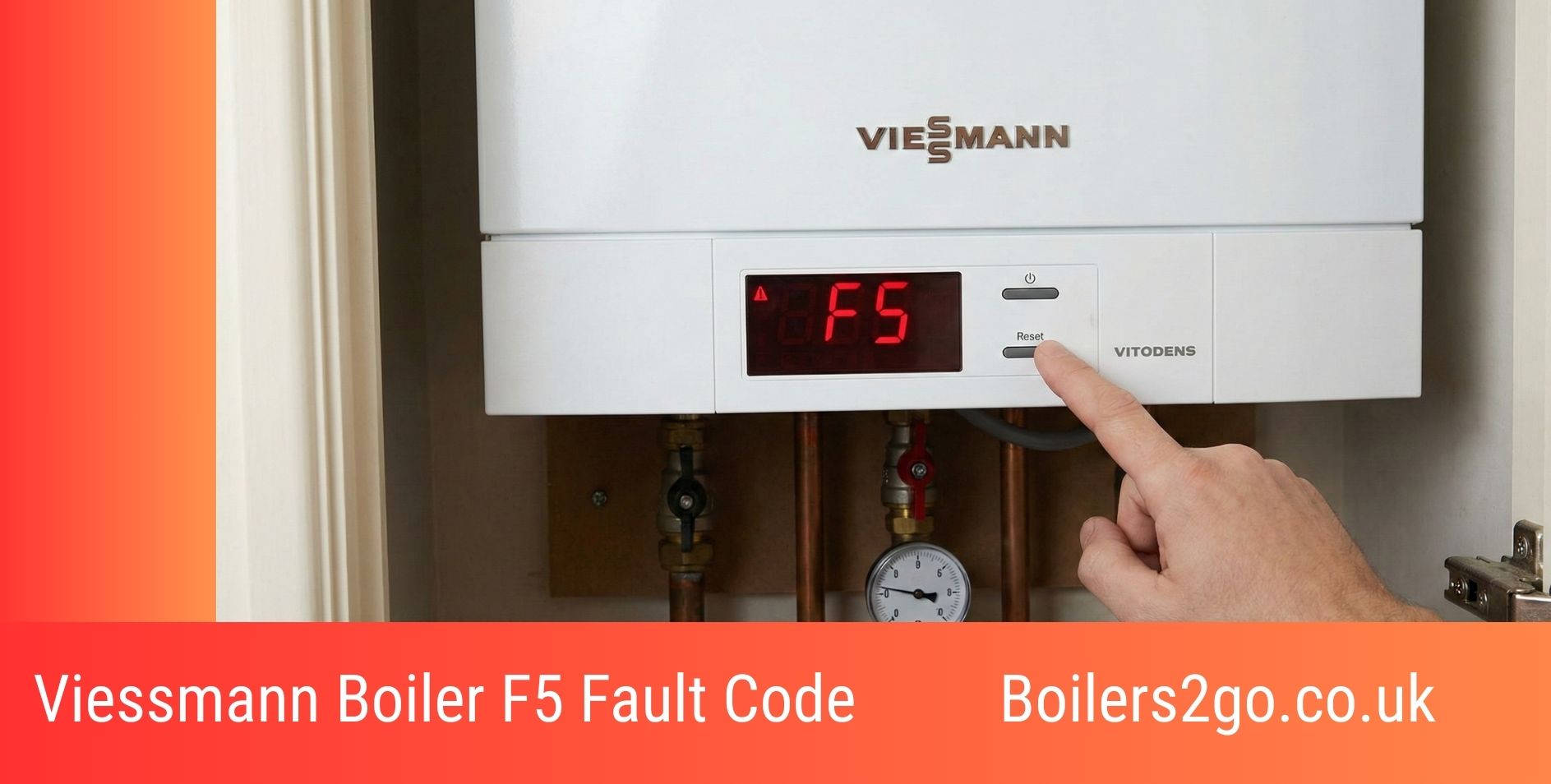
The F5 fault code on a Viessmann boiler means the air pressure switch has not confirmed correct fan operation during the start-up sequence. The boiler’s PCB requires this confirmation before allowing the gas valve to open: without it, the system locks out to prevent combustion gases from being released unsafely into the home.
F5 is one of the more frequently reported fault codes on the Vitodens 100-W and 200-W ranges. Viessmann’s own service documentation defines it as an air pressure switch fault, though in practice the cause is often something adjacent to the switch itself: a sticking mixture damper on pre-2015 models, a partially blocked flue terminal, or a fan that is not reaching its operating speed.
This guide explains what each underlying cause looks like, what you can safely check yourself, and where a Gas Safe engineer is the only appropriate next step. For a broader overview of codes on the Vitodens range, the common issues with Viessmann boilers article covers the full fault code set. Related codes worth understanding alongside F5 are the viessmann boiler f2 fault code (overheating fault) and the viessmann boiler f1 fault code (water temperature sensor fault), both of which can sometimes appear alongside F5 on poorly maintained systems.
Watch Our Quick Video Guide Here:
What Does the Viessmann F5 Fault Code Actually Mean?
F5 specifically indicates that the air pressure switch did not open when the burner started, or did not close when the fan reached operating speed. These are the two conditions the PCB checks during every start-up sequence.
The fan runs first, creating a draught that draws air through the burner and pushes flue gases out through the external flue terminal. The air pressure switch sits in this airflow path and detects the change in pressure when the fan is running correctly. If it does not register the expected pressure differential, the PCB concludes that the flue gas exhaust system is not functioning safely and prevents ignition.
The practical result is a boiler that locks out immediately after the fan starts, with no heat or hot water. A single reset attempt (press and hold the reset button marked with an ‘R’ for 3 seconds, or tap the reset warning on touchscreen Vitodens models) is worth trying before investigating further. If F5 returns immediately, there is an underlying fault that needs identifying. Do not keep resetting: repeated lockouts without fixing the cause can damage components.
For the full reset procedure on your specific model, the how to reset viessmann boiler guide covers the steps for each Vitodens range.
Viessmann F5 Fault Code: Causes at a Glance
The table below summarises all the main causes of an F5 fault, what each one does to the system, whether a homeowner can check it safely, and the typical repair cost range in 2026.
| Cause | What Goes Wrong | DIY Check? | Typical Repair Cost |
|---|---|---|---|
| Faulty air pressure switch | Switch fails to confirm fan airflow; PCB locks out | Flue terminal only | £50 to £120 for switch replacement |
| Sticking mixture damper (pre-2015 models) | Metal flap sticks to rubber seal; fan can’t open it | No — engineer only | Under £30 for part; labour extra |
| Fan failure | Fan not reaching operating speed; APS never trips | No — engineer only | £150 to £300 inc. labour |
| Blocked or dirty flue terminal | Debris restricts exhaust; pressure switch reads high backpressure | Yes — clear from ground level | Free DIY fix |
| Low or inconsistent gas supply | Insufficient gas pressure for stable combustion | Check ECV position only | Free if meter issue; £150 to £300 for valve |
| Blocked or dirty burner | Limescale or soot disrupts air-gas mixture | Basic visual only | £80 to £150 for service clean |
| Faulty flame sensor | Ionisation probe can’t read flame; PCB shuts down | Clean probe tip only | £40 to £80 for sensor replacement |
| Frozen or blocked condensate pipe | Backed-up condensate raises internal pressure | Yes — thaw with warm water | Free DIY; £100 to £200 for rerouting |
| PCB fault | Control board incorrectly reads or sends signals | No — engineer only | £300 to £500 for PCB replacement |
1. Faulty Air Pressure Switch
The air pressure switch is a small electromechanical component that measures the differential pressure created by the fan. When the fan is running correctly, it creates a pressure difference across the switch that closes its internal contacts and sends a confirmation signal to the PCB. A switch that is corroded, worn, or has developed an electrical fault cannot send this signal reliably, causing an F5 lockout even when the fan itself is working normally.
This is more common on older installations and boilers that have been in service for more than eight to ten years. In humid locations or boiler cupboards with poor ventilation, moisture accelerates corrosion on the switch contacts and connecting tubes.
What a Gas Safe Engineer Will Do
- Isolate the boiler’s power at the fused spur and close the gas isolation valve.
- Inspect the switch for visible damage, cracked housing, or loose wiring at both the switch body and PCB terminals.
- Test the switch with a multimeter: with the fan off, the switch should show an open circuit; when the fan is energised and creating airflow, it should close (near-zero resistance). Erratic or consistently open readings confirm switch failure.
- Replace with a compatible OEM switch if faulty. Typical parts cost is under £100; total repair including labour is usually £50 to £120.
- Reset the boiler and run through several ignition cycles to confirm stable operation.
This cause accounts for approximately 40% of F5 faults on Vitodens models, according to Viessmann service data cited in independent heating engineer forums.
2. Sticking Mixture Damper (Pre-2015 Vitodens Models Only)
On Vitodens 100-W and 200-W models manufactured before approximately 2015, a small metal flap called the mixture damper sits at the fan outlet. It closes by gravity when the boiler is off, sealing the outlet to prevent cold air ingress. When the fan starts, the air pressure pushes the flap open, which is part of the signal the air pressure switch relies on.
The rubber seal that the flap rests on can develop a sticky surface over time as it ages and is repeatedly heated. When this happens, the flap sticks to the seal and the fan cannot push it open, causing the air pressure switch to register insufficient airflow and triggering F5.
Viessmann removed this component from later production runs because of the known sticking issue. If your Vitodens was manufactured after 2015, this cause does not apply to your boiler.
What a Gas Safe Engineer Will Do
- Access the fan outlet assembly inside the boiler.
- Inspect the flap and rubber seal. If the seal is sticky, the options are: split the rubber seal with a knife so the flap no longer contacts it (some engineers’ preferred approach), or replace the entire damper assembly (parts typically under £30).
- If the damper is removed or modified, Viessmann’s current guidance should be confirmed with the installer, as modifications must be noted in the service record.
- Test the boiler through multiple start-up cycles to confirm the fan opens the outlet fully and the air pressure switch reads correctly.
Do not attempt to access or modify the mixture damper yourself. The fan assembly is adjacent to the combustion chamber and requires isolation of both gas and electrical supplies.
3. Fan Failure
If the fan itself is not running at the correct speed, or not running at all, the air pressure switch will never detect the expected differential and F5 will appear. The fan is what creates the draught that the entire start-up sequence depends on: without it, neither ignition nor flue gas evacuation is safe.
Fan faults on Viessmann boilers present in two patterns: the boiler fires and then locks out immediately (fan running but below speed), or the boiler does not attempt ignition at all (fan not running). If you can hear the fan starting when the boiler demands heat, but F5 appears shortly after, a faulty air pressure switch or dirty venturi tubes are more likely than a failed fan motor.
What a Gas Safe Engineer Will Do
- Check that the fan starts when heat is demanded and listen for unusual noise (grinding, rattling, or silence).
- Use a multimeter to test the fan’s electrical supply and measure its operating speed against the manufacturer’s specification.
- Inspect the venturi tubes (small rubber hoses connecting the fan assembly to the air pressure switch) for splits, kinks, or blockages. A blocked venturi gives the same symptom as a slow fan.
- Replace the fan assembly if the motor is faulty. Typical cost is £150 to £300 including labour. Venturi tube replacement is considerably cheaper at around £20 to £50 for parts.
4. Blocked or Obstructed Flue Terminal
If the external flue terminal is blocked by leaves, birds’ nesting material, wasp nests, or accumulated snow in winter, backpressure builds in the flue and the air pressure switch detects an abnormal reading. This is the one F5 cause that a homeowner can check and potentially fix without any engineering work.
What You Can Check and Fix
- Locate the external flue terminal: usually a circular or rectangular grille on an outside wall, typically in the direction the boiler is mounted internally.
- Inspect it visually from ground level. Clear any visible debris, leaves, or obstruction from the grille using a gloved hand or a soft brush. Ensure nothing is within 300 mm of the terminal.
- Reset the boiler once the terminal is clear. Press and hold the reset button for 3 seconds (or use the touchscreen on Vitodens 200/222 models).
- If F5 returns within a few minutes of the boiler starting, the cause is internal (fan, air pressure switch, or burner) and a Gas Safe engineer needs to diagnose it.
Fitting a bird guard over an unprotected flue terminal prevents nesting and debris blockage. These are low-cost and straightforward to fit, though the correct terminal guard for your specific Vitodens model should be confirmed with a Viessmann-registered engineer.
5. Low or Inconsistent Gas Supply
If gas pressure at the burner is insufficient for stable combustion, the flame either fails to establish or establishes weakly and then fails, and the air pressure switch reports anomalous conditions. The most common causes in UK properties are a closed or partially closed emergency control valve, a frozen gas meter regulator in cold weather, or a gas valve that has started to stick.
What You Can Check
- Test another gas appliance (hob or cooker). If that also has no supply, the issue is with the incoming gas rather than the boiler.
- Locate the emergency control valve (ECV) at the gas meter and confirm the lever is parallel to the pipe (open position). A lever perpendicular to the pipe means it is closed.
- If the meter is outside in winter and the pipework looks frosted, pour warm water gently over the regulator to thaw it.
- If supply is live and the ECV is open but F5 persists, a Gas Safe engineer must test gas pressure at the meter, inlet filter, and gas valve to identify where the restriction is occurring.
The minimum gas supply pressure for most Viessmann Vitodens models is 17.5 mbar at the burner under maximum demand. A Gas Safe engineer with a manometer can verify this within minutes.
6. Blocked or Dirty Burner Assembly
Limescale, soot, or debris accumulating in the burner assembly disrupts the air-to-gas mixture ratio. When the mixture is outside the correct range, combustion is unstable or absent, and the flame detection system and air pressure switch together trigger the F5 lockout. This is more common in hard water areas such as the South East, East Anglia, and parts of the Midlands, where limescale deposits build faster.
Burner contamination typically develops gradually and is caught during annual servicing before it causes a fault. When it does cause F5, it is usually in boilers that have been without a service for two or more years.
What a Gas Safe Engineer Will Do
- Power down the boiler and allow it to cool fully before accessing the burner.
- Remove the burner assembly, inspect for soot, limescale deposits, or visible damage to the burner surface.
- Clean with a soft brush or, where limescale is present, a manufacturer-approved descaling solution. Reassemble and inspect the ignition electrode for carbon deposits, cleaning or replacing as needed.
- Run a combustion analysis after reassembly using a flue gas analyser to confirm the air-to-gas ratio is within Viessmann’s specification.
- Fitting a magnetic system filter on the return and dosing with inhibitor reduces the rate at which debris enters the boiler, extending the clean interval.
7. Faulty Flame Sensor
The flame sensor (ionisation probe) confirms that combustion is happening by detecting the electrical current passing through the flame. If the probe tip is coated with soot or oxidisation, or has shifted slightly out of position, it cannot read the ionisation current reliably. The PCB interprets this as a failed ignition and shuts down, which can produce an F5 code if the sequence fails during the air pressure phase.
The diagnostic pattern for a faulty flame sensor is the boiler firing briefly (one to two seconds of visible flame) and then cutting out. If the boiler never attempts ignition at all, the cause is more likely the fan, the APS, or the gas supply.
What You Can Safely Do
- With the boiler powered off, open the front casing and locate the sensor probe near the burner head.
- Inspect the metal probe tip for black soot deposit or a grey oxidised surface. Gently clean it with fine emery paper to restore conductivity.
- Do not adjust the probe’s physical position unless you have the manufacturer’s specification for its alignment relative to the burner flame. Misalignment causes the same symptom as contamination.
- If cleaning does not clear the F5 fault, the probe or the PCB signal path needs professional diagnosis and likely replacement.
8. Frozen or Blocked Condensate Pipe
Viessmann Vitodens boilers are condensing units that produce acidic condensate water as a byproduct of high-efficiency combustion. This drains through the condensate pipe to an external drain or soil pipe. In freezing weather, the external section can freeze solid, backing up condensate inside the boiler and creating internal pressure anomalies that confuse the air pressure switch and trigger F5.
This is particularly common on Vitodens installations in flats where the condensate pipe run is longer than in a typical house, giving more surface area to freeze. Properties in exposed, north-facing positions with uninsulated external pipe runs are most vulnerable.
How to Fix a Frozen Condensate Pipe
- Locate the white plastic pipe (typically 21 mm or 32 mm) leaving the boiler through an external wall.
- Pour warm water (not boiling) slowly along the frozen external section until water flows freely. A hot water bottle held against the pipe for 10 to 15 minutes also works for less severe freeze-ups.
- Reset the boiler once drainage is clear.
- Insulate the external pipe run with foam lagging to reduce the risk of refreezing. For repeat freeze-ups, trace heating cable is more reliable.
9. PCB Fault
If all other causes have been ruled out and F5 persists, the PCB (printed circuit board) may be generating or misreading the fault. A PCB can fail partially, displaying incorrect fault codes as its diagnostics degrade, or fail entirely, preventing any start-up.
Water ingress from an internal boiler leak is the most common cause of PCB failure on Viessmann boilers: a dripping pump seal or diverter valve can allow water to reach the board over months. On Vitodens models over 12 years old, PCB component fatigue is also a possibility.
PCB replacement costs £300 to £500 including parts and labour on most Vitodens models. Before authorising the replacement, a Gas Safe engineer should confirm that all other potential causes have been tested, as a new PCB fitted into a boiler with an unresolved gas valve or fan fault will display the same code again.
How to Prevent the F5 Fault Code
- Annual servicing by a Gas Safe engineer. This is the single most effective prevention measure: a full service includes fan testing, APS inspection, burner cleaning, flue integrity check, and condensate drain verification.
- Fit a magnetic system filter on the return pipe if one is not already present. This catches magnetite and debris before it reaches the burner.
- Insulate external condensate pipe runs before winter, particularly in loft installations or long external runs.
- Check the external flue terminal at the start of each heating season for debris, bird activity, or plant growth encroaching within 300 mm.
- In hard water areas, consider a scale reducer on the cold mains inlet to slow limescale build-up in the heat exchanger and burner.
- Install a Viessmann ViCare smart thermostat or connect the boiler to the ViCare app if your Vitodens model supports it. The app logs error codes with timestamps, which can identify patterns (for example, F5 always appearing in cold weather) that point to a specific cause before a callout is needed.
When You Must Call a Gas Safe Engineer
Attempt one reset after any DIY fix (clearing the flue terminal, thawing the condensate pipe). If F5 returns immediately, stop and call a Gas Safe engineer. The following situations require immediate professional attention:
- F5 returns after a single reset with no DIY cause found
- You smell gas at any point: leave the property, open windows if safe, and call 0800 111 999
- The boiler is making banging, grinding, or rattling noises before locking out
- The boiler is still under its Viessmann warranty: DIY intervention beyond basic resets and flue terminal inspection can void warranty cover
- Any access to internal components including the fan, APS, burner, or gas valve is required
Labour rates for Viessmann-registered engineers currently run between £80 and £120 per hour in 2026. Use the official Viessmann installer finder at viessmann.co.uk or the Gas Safe Register at gassaferegister.co.uk to find a qualified engineer in your area.
FAQs
Does the F5 fault code affect my Viessmann warranty?
The F5 code itself does not void your warranty, provided it is investigated and repaired by a Viessmann-approved engineer within the warranty period (typically 5 to 12 years depending on model and installer). What can lead to warranty claim denials is evidence of skipped annual services, DIY repairs beyond approved homeowner actions, or third-party parts not approved by Viessmann. Keep all service records and ensure the boiler is registered on the Viessmann system.
Can cold weather trigger an F5 fault even when nothing is wrong with the boiler?
Yes, through two mechanisms. First, a frozen condensate pipe creates internal pressure anomalies that can trigger F5 on Vitodens models before any other code appears. Second, a frozen gas meter regulator can reduce gas supply pressure below the minimum threshold, causing the burner to fail to establish a stable flame. Both of these are weather-related rather than mechanical faults and can usually be resolved with DIY thawing followed by a reset.
Is F5 more common on older Viessmann models?
Yes, for two reasons. Pre-2015 Vitodens models have the mixture damper component that is prone to sticking on its rubber seal and is one of the most commonly reported F5 causes on those models. Newer models do not have this component. Additionally, air pressure switches on older models have had more years of thermal cycling, humidity exposure, and vibration, making electrical faults more likely. If your pre-2015 Vitodens has had multiple F5 occurrences, the mixture damper and air pressure switch are the first two components worth checking.
How does the F5 fault code affect my energy bills?
An F5 lockout shuts the boiler down entirely, so there is no gas consumption while the boiler is locked out. However, a boiler that is short-cycling due to a marginal F5 fault (starting, running briefly, then locking out and restarting) uses more gas per unit of useful heat than a boiler running a full heating cycle, because each ignition sequence involves running the fan and pre-purge cycle. If your boiler is locking out several times a day before eventually running, your gas usage for that period will be higher than usual.
Can a smart thermostat help diagnose F5?
The Viessmann ViCare app, which connects to the Vitodens 100-W and 200-W via WiFi on models equipped with the Viessmann gateway, logs fault codes with timestamps. This is genuinely useful for diagnosing intermittent F5 faults that only occur overnight or during specific demand periods, because the log allows an engineer to see the pattern before attending. Other smart thermostats (Hive, Nest, Tado) provide alerts when heating fails to reach target temperatures, which is indirect evidence of a lockout, but they do not retrieve or display Viessmann-specific fault codes.

I’m Penny North, a home energy heating expert. My mission is to demystify new boilers and complex heating systems to help you achieve a warm, cosy home with lower energy bills and a smaller environmental footprint.