

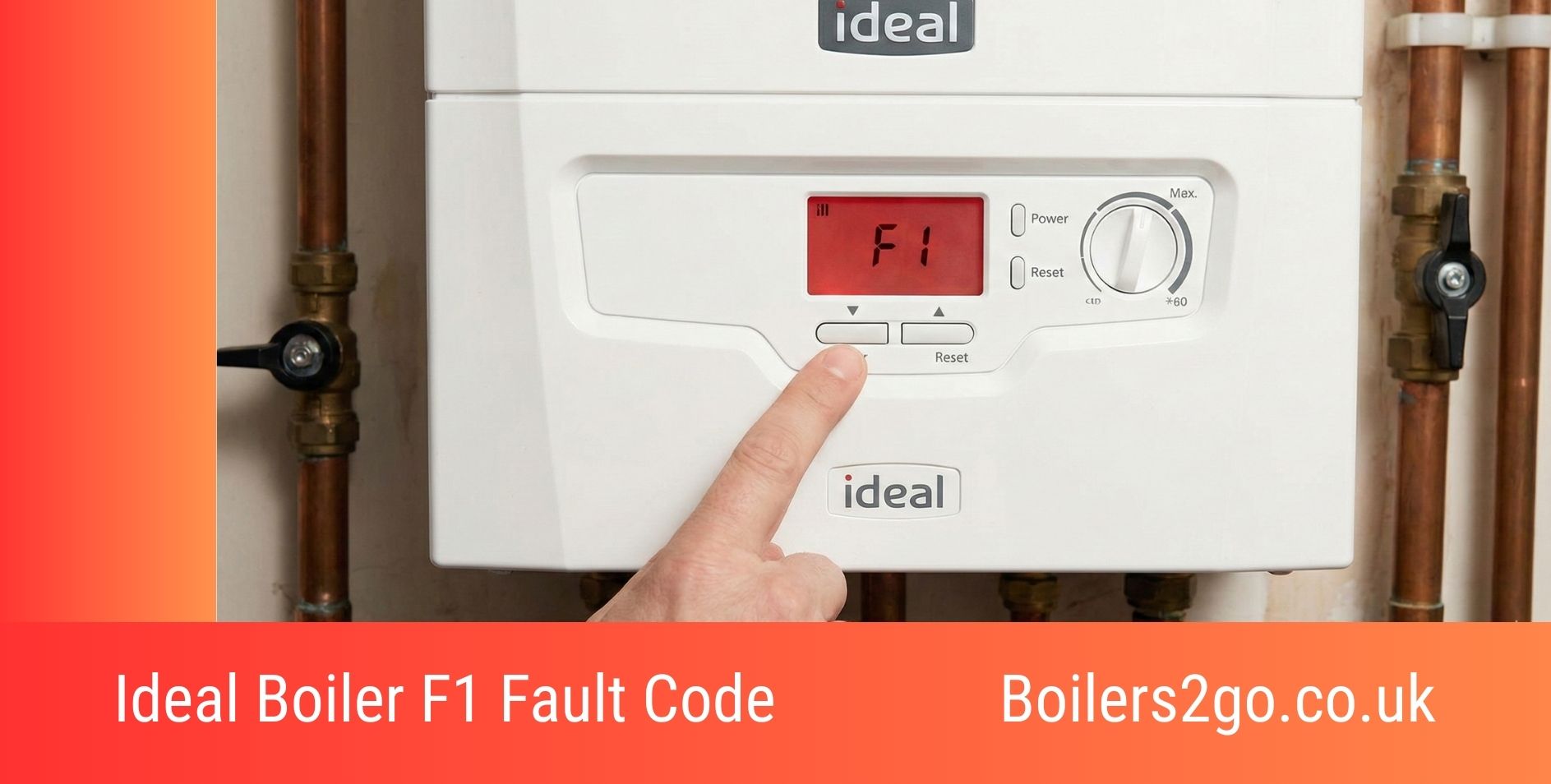
Seeing the Ideal boiler F1 fault code appear on your boiler display can be worrying, especially on a cold winter morning. This common error on Ideal Logic, Logic+, Independent, Vogue and many other Ideal combi and system boilers simply means your boiler has detected low water pressure or an issue that’s stopping it from building the correct system pressure.
Get a boiler cover, repair and annual service plan online here >
The good news? In most cases, this is something you can fix themselves in minutes – without needing an engineer.
In this guide, I’ll explain exactly what the F1 fault code on an Ideal boiler means, the real causes behind it, and step-by-step fixes for each one.
Get a quote today and take the stress out of replacing your boiler. At Boilers2Go, we offer fast, reliable installation across the UK - often as soon as the next day. 
Need a new boiler?
What Does the Ideal Boiler F1 Fault Code Mean?
The Ideal boiler F1 fault code actually means that the water pressure inside your central heating system has dropped below 0.5 bar (sometimes as low as 0.3–0.4 bar). Ideal boilers are designed to lock out and display the F1 error when pressure is too low to protect the heat exchanger and pump from damage. To resolve the F1 fault code, it’s essential to check the pressure gauge and ensure it is within the proper range. It is easily confused with F2, which looks similar on the display but means the boiler has lost its flame, and our Ideal boiler F2 fault code guide covers that fault.
If the pressure is indeed low, you may need to refill the system using the filling loop. For other codes, see our full guide to Ideal boiler error codes.
This code typically indicates a problem related to the flame detection system, which can prevent the boiler from operating efficiently. Addressing these fault codes promptly ensures that your heating system remains safe and effective.
Unlike some other brands that use “FL” or just “Low Pressure”, Ideal uses the specific F1 code for this problem.
You’ll usually see the F1 fault flashing or permanently displayed, and the heating and hot water will stop working until the pressure is restored.
What Causes the Ideal F1 Fault Code?
The F1 fault code is caused by one (or a combination) of the following issues. Here are the most common reasons UK homeowners and landlords see this error:
1. Normal Pressure Drop Over Time
Normal pressure drop over time happens because tiny amounts of water and air escape through joints, radiator valves and the pressure relief valve (PRV). This is the number one reason for F1 faults in the UK.
How to fix normal pressure drop:
- Locate the filling loop (usually a flexible silver hose or two black/silver valves under the boiler).
- Slowly open both valves (or the single valve on newer external loops) until you hear water flowing.
- Watch the pressure gauge rise to 1–1.5 bar (Ideal recommends 1.2–1.5 bar when cold).
- Close the valves tightly and check for leaks at the connection points.
- Reset the boiler by pressing the reset button or holding the reset option for 3–5 seconds.
2. A Recent Radiator or System Drain
A recent radiator or system drain for bleeding radiators, replacing a radiator, or DIY plumbing work lets air in and water out, causing an instant drop.
How to fix after a radiator or system drain:
- Re-pressurise exactly as above using the filling loop.
- Bleed all radiators starting from the lowest floor upwards to remove trapped air.
- Top up again if pressure drops after bleeding (this is normal).
- Reset the boiler.
3. Leaking Pressure Relief Valve (PRV)
A leaking pressure relief valve (PRV) is the orange or yellow pipe outside that drips constantly or in bursts. This valve is designed to open at 3 bar, but if the washer inside fails, it drips even at normal pressure.
How to fix a leaking PRV (temporary):
- Tie the external discharge pipe upwards (above the boiler level) using string or a cable tie – this often stops the drip temporarily.
- Book a Gas Safe engineer to replace the PRV (costs £100–£180 typically).
4. Hidden Leak on the Heating System
A hidden leak on the heating system (under floorboards, in walls, or a slow drip from a radiator valve) can cause gradual pressure loss over days or weeks.
How to fix a hidden leak:
- Check all visible pipework and radiator valves for damp patches or corrosion.
- Look for water stains on ceilings or under floorboards.
- If you can’t find it, a Gas Safe engineer can perform a pressure test and use leak-sealant or trace and repair the pipe.
5. Faulty Pressure Sensor (Rare)
A faulty pressure sensor (rare) can give a false F1 reading even when pressure is correct.
How to fix a faulty pressure sensor:
- This requires a multimeter test and replacement by a Gas Safe registered engineer only.
Get a quote today and take the stress out of replacing your boiler. At Boilers2Go, we offer fast, reliable installation across the UK - often as soon as the next day.
Need a new boiler?
How to Repressurise an Ideal Boiler: Step-by-Step
- Find your filling loop – most Ideal Logic and Vogue models have an integrated key or braided hose underneath.
- Insert the key (if required) and turn anti-clockwise to open.
- Open the second valve slowly.
- Listen for water entering the system.
- Stop when the gauge reaches the green zone or 1.2–1.5 bar.
- Close both valves firmly and remove the key.
- Reset the boiler – the F1 code should clear.
How to Prevent the Ideal F1 Fault Code in the Future
Preventing the Ideal F1 fault code in the future is straightforward:
- Check your boiler pressure every 2–3 months (especially before winter).
- Have your boiler serviced annually by a Gas Safe engineer – they’ll spot weeping valves early.
- Fit a magnetic system filter (e.g., MagnaClean or Fernox TF1) to reduce corrosion and sludge that can damage seals.
- If you have repeated pressure loss, ask your engineer to fit an automatic filling loop or external filling link to make topping up easier.
When Should You Call a Gas Safe Engineer About an Ideal F1 Fault?
You absolutely MUST call a Gas Safe engineer if:
- The pressure won’t stay above 0.5 bar after repressurising (drops within hours or days).
- You see water dripping constantly from the external PRV pipe (even after tying it up).
- There are signs of a leak inside the boiler casing itself.
- The F1 fault returns immediately after resetting.
- You’re a landlord – you have a legal duty under the Gas Safety (Installation and Use) Regulations 1998 to use only Gas Safe registered engineers for repairs.
Ideal Boiler F1 Fault Code: FAQs
Will My Ideal Boiler Still Produce Hot Water With an F1 Fault?
In most cases, no – both heating and hot water stop because the boiler locks out completely for safety.
Is the F1 Fault Covered by My Ideal Boiler Warranty?
Yes, if your boiler is still in warranty (usually 5–12 years depending on model), low pressure caused by a manufacturing fault (e.g., faulty expansion vessel or PRV) is covered – but you must use an Ideal-approved engineer.
Can I Ignore the F1 Code If the Heating Still Works Sometimes?
No – running the boiler with low pressure can seriously damage the heat exchanger, leading to expensive repairs (£400–£1,200).
Why Does My Ideal Boiler Pressure Rise Above 2.5 Bar Then Drop to F1?
This is usually a failing expansion vessel that has lost its air charge. Only a Gas Safe engineer can re-charge or replace it.
Do Any Ideal Boiler Models Not Show F1 for Low Pressure?
Older Ideal Classic, Isar and HE models sometimes show “L F” or just a flashing light instead of F1, but all current Logic, Logic+, Vogue, Independent and Max ranges use the F1 code.
Get a quote today and take the stress out of replacing your boiler. At Boilers2Go, we offer fast, reliable installation across the UK - often as soon as the next day.
Need a new boiler?

I’m Penny North, a home energy heating expert. My mission is to demystify new boilers and complex heating systems to help you achieve a warm, cosy home with lower energy bills and a smaller environmental footprint.