

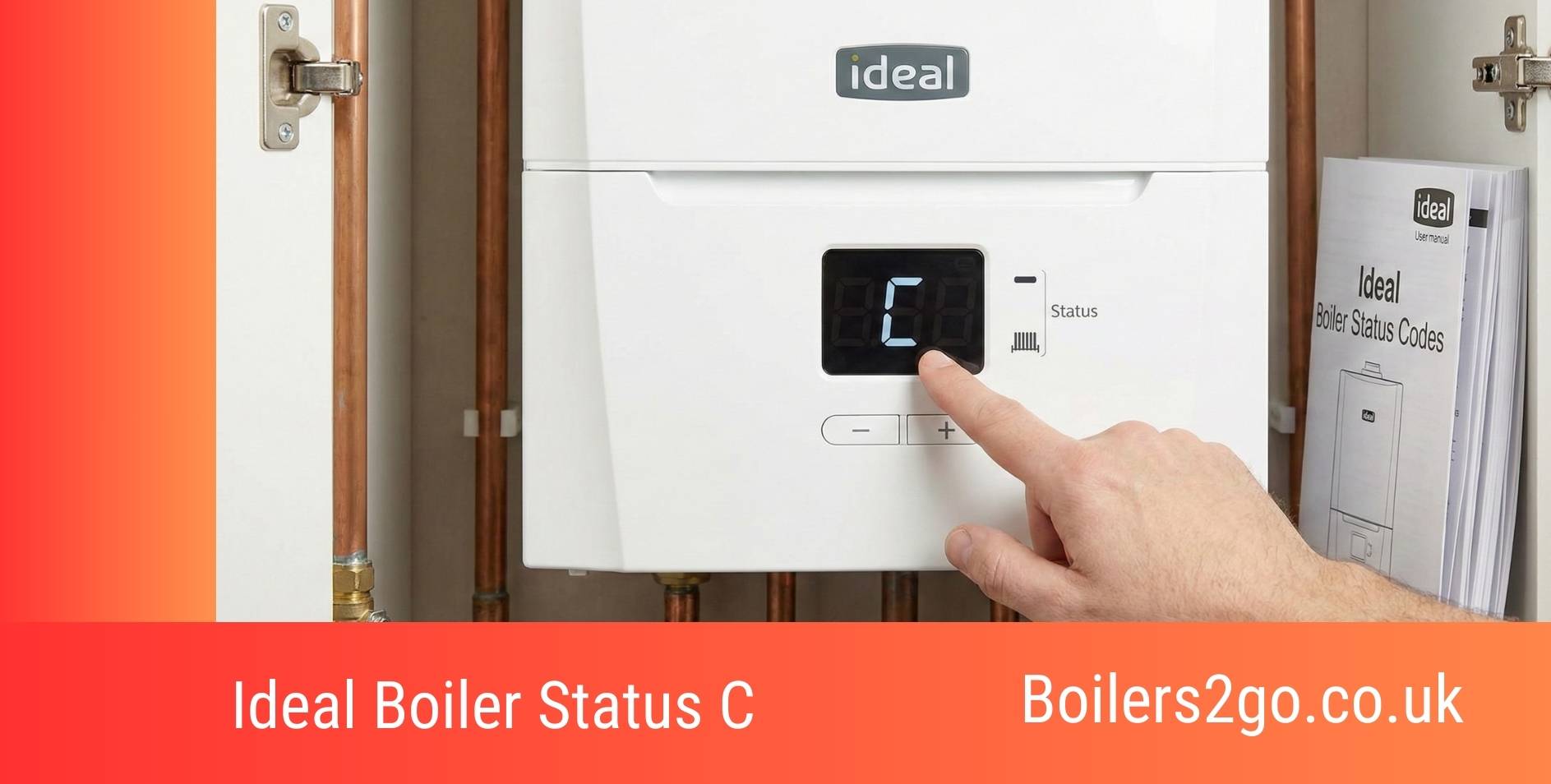
Seeing a “C” on your Ideal boiler display tends to cause more worry than it should. The good news is that Status C is not a fault code at all. It is simply telling you the boiler is doing its job and actively heating your home.
This guide explains exactly what Status C means, when it is completely normal, and the specific situations where it points to a genuine problem. We will also cover the practical fixes for each cause and when the issue needs a Gas Safe engineer rather than a DIY attempt.
If your boiler also shows an F1 or L2 code alongside Status C, our guide to Ideal boiler error codes explains what those mean. For an FL code specifically, see our guide to the Ideal boiler FL fault code.
Get a boiler cover, repair and annual service plan online here >
Watch Our Video on Ideal Boiler Status C
What Does Status C Mean on an Ideal Boiler?
Status C on an Ideal boiler means the boiler has received a demand for central heating and is actively burning fuel to heat water. That hot water then circulates through your radiators or underfloor heating system to warm your home.
Unlike fault codes such as F1 or L2, Status C is not an error indicator. It is a normal operating status that should appear every time your thermostat calls for heat, whether that demand comes from your programmer, a smart thermostat, or simply the room temperature dropping below your set point.
The display varies slightly by model. The Ideal Logic range shows a steady “C” on the screen. The Ideal Vogue range displays “CH ON” instead, which means exactly the same thing: the boiler is actively heating.
Steady C vs Flashing C: What Is the Difference?
This distinction matters more than most articles on this topic explain, and it is the quickest way to tell if everything is fine or whether something needs attention.
A steady C with the burner light on: Completely normal. The boiler is actively firing and heating water. No action needed.
A steady C with the burner light off: Also normal in many cases. This means your home has reached the set temperature and the boiler is staying in heating mode, ready to fire again the moment temperature drops. Think of it as the boiler keeping watch rather than actively working.
A flashing C, or C displayed with no heat being produced: This is the situation that needs investigating. If the burner light is flashing, or the status shows C but your radiators stay cold and the target temperature is never reached, one of the underlying causes below is likely responsible.
What Causes Ideal Boiler Status C to Show When It Shouldn’t?
When Status C persists without your home actually warming up, the boiler thinks there is ongoing demand for heat but something is preventing that demand from being met. In our experience, these faults are more common on older Ideal Logic and Vogue models, and more frequent in hard-water areas such as London and the South East, where limescale accelerates component wear.
Faulty Thermostat
A faulty thermostat can send incorrect signals that keep the boiler in C mode even after a room has reached a comfortable temperature. This is one of the most common and easiest causes to rule out.
- Check the thermostat settings. Confirm it is set to the correct temperature and mode. A simple adjustment sometimes resolves the issue immediately.
- Replace the batteries if it is a wireless thermostat. Low batteries cause erratic signals long before the display shows a low battery warning.
- If recalibrating and replacing batteries does not help, have a Gas Safe engineer check for wiring faults or a damaged sensor.
Stuck Zone Valve
A stuck zone valve prevents water from flowing correctly around the system, which can cause the boiler to remain active longer than it should as it tries to satisfy a heat demand that is not being delivered to the radiators.
- Locate the valve and try the manual override lever to open it temporarily. Listen for movement or a click as it releases.
- If accessible, apply a light lubricant to the mechanism. Avoid forcing it, as this can snap internal components.
- For a valve that keeps sticking, a qualified engineer should fit a replacement motorised valve to restore reliable flow.
Pump Failure or Seizure
If the pump is not circulating water properly, the boiler can stay in C mode as it tries to compensate for the lack of heat reaching the radiators. A seized or failing pump is one of the more serious causes on this list.
- Bleed the radiators to release any trapped air, which improves flow and reduces strain on the pump.
- Listen for unusual humming or grinding from the pump. A gentle tap on the pump housing can sometimes free a lightly seized impeller, but do this cautiously.
- If the pump has genuinely seized or worn out, a Gas Safe engineer will need to fit a replacement. This is often covered under warranty if the boiler is still within its cover period.
Low Water Pressure
Low system pressure can mimic a heat demand issue, keeping Status C displayed because the boiler cannot circulate water effectively at low pressure.
- Check the pressure gauge. It should read between 1.0 and 1.5 bar when the system is cold. Repressurise using the filling loop if it has dropped below this.
- Inspect visible pipework and radiators for drips or damp patches that might explain the pressure loss.
- In hard-water regions, a power flush carried out by a qualified engineer can clear scale-related blockages that contribute to pressure drops.
PCB Malfunction
The printed circuit board (PCB) is the boiler’s control centre. If it malfunctions, it can misinterpret signals and falsely keep Status C active even when there is no genuine heat demand.
- Reset the boiler by turning it off at the mains, waiting 30 seconds, then restarting. This clears many temporary glitches.
- A visual check for obviously burnt or damaged components can be done if you feel confident, but do not attempt to touch or repair anything inside the casing.
- A PCB fault usually requires specialist replacement. Contact a Gas Safe engineer or Ideal’s technical support for diagnostics before ordering parts.
How to Prevent Ideal Boiler Status C Issues
Most of the causes above develop gradually rather than appearing overnight. A few consistent habits significantly reduce the chances of a genuine fault hiding behind a normal-looking status.
- Book an annual Gas Safe service. This catches early signs of pump wear, valve sticking, and pressure issues before they cause a persistent C status.
- Insulate exposed pipework to reduce pressure fluctuations caused by temperature swings, particularly in lofts and unheated spaces.
- Check your thermostat’s performance periodically, especially after any battery change or software update on smart thermostats.
- In hard-water areas, fit a scale reducer or consider a water softener to slow limescale build-up in the heat exchanger and valves.
- Landlords should build annual servicing into tenancy management routines, both for reliability and to meet UK gas safety obligations for rented properties.
For wider guidance on keeping a heating system efficient, the Energy Saving Trust has useful background reading on boiler maintenance and efficiency.
What to Do If DIY Fixes Don’t Resolve Status C
If you have checked the thermostat, bled the radiators, confirmed pressure is correct, and Status C is still showing without your home heating up properly, stop trying further DIY fixes and call a Gas Safe registered engineer.
Pushing on without the right expertise risks masking a more serious fault, and in rare cases can increase the risk of issues like carbon monoxide leaks if internal components are tampered with incorrectly. It is never worth the risk to save a call-out fee.
You can verify any engineer’s Gas Safe registration before they visit using the official Gas Safe Register. If your boiler is still under warranty, contact Ideal directly first, as DIY repairs on internal components can affect your cover.
Ideal Boiler Status C: FAQs
Can Ideal Boiler Status C Affect My Energy Bills?
Yes, if Status C persists due to an underlying inefficiency such as poor circulation or a stuck valve, the boiler works harder and longer than it needs to. This shows up as higher gas usage over time. Resolving the root cause restores normal, efficient operation.
Is Status C Different on an Ideal Combi vs System Boiler?
On combi boilers, Status C relates directly to central heating demand. On system boilers, it can also interact with the hot water cylinder, since the boiler may be heating the cylinder rather than the radiators at any given moment. If you have a system boiler and Status C persists with cold radiators, check whether the cylinder is calling for heat before assuming a fault.
How Does Hard Water Affect Ideal Boiler Status C?
Hard water accelerates limescale build-up inside the heat exchanger, pump, and valves. This can mimic circulation faults and trigger Status C displays that do not resolve quickly, especially across the South East and other hard-water regions of the UK. A scale reducer or water softener slows this process considerably.
Does Boiler Age Make Ideal Status C Problems More Likely?
Yes. Ideal boilers over 10 years old are more prone to component wear, particularly in pumps and zone valves, which increases the likelihood of Status C appearing without a genuine heat demand being met. Regular servicing extends component life, but age-related wear eventually becomes a factor in any boiler. If you have an older Ideal Isar, our guide to Ideal Isar boiler problems covers the faults that range is most prone to.
Will a Smart Thermostat Help Prevent Status C Issues?
A smart thermostat such as Hive, Nest, or Tado can provide more precise temperature control than a basic dial thermostat, which reduces false or prolonged heat demands. It will not fix a mechanical fault like a stuck valve or worn pump, but it can reduce the chances of thermostat-related causes of persistent Status C.
Is It a Problem If My Ideal Boiler Shows C but the Burner Light Is Off?
Not necessarily. This usually means your home has reached the target temperature and the boiler is staying in heating mode, ready to fire again as soon as the temperature drops. As long as your radiators were warm beforehand and the room feels comfortable, this is normal operation rather than a fault.

I’m Penny North, a home energy heating expert. My mission is to demystify new boilers and complex heating systems to help you achieve a warm, cosy home with lower energy bills and a smaller environmental footprint.