

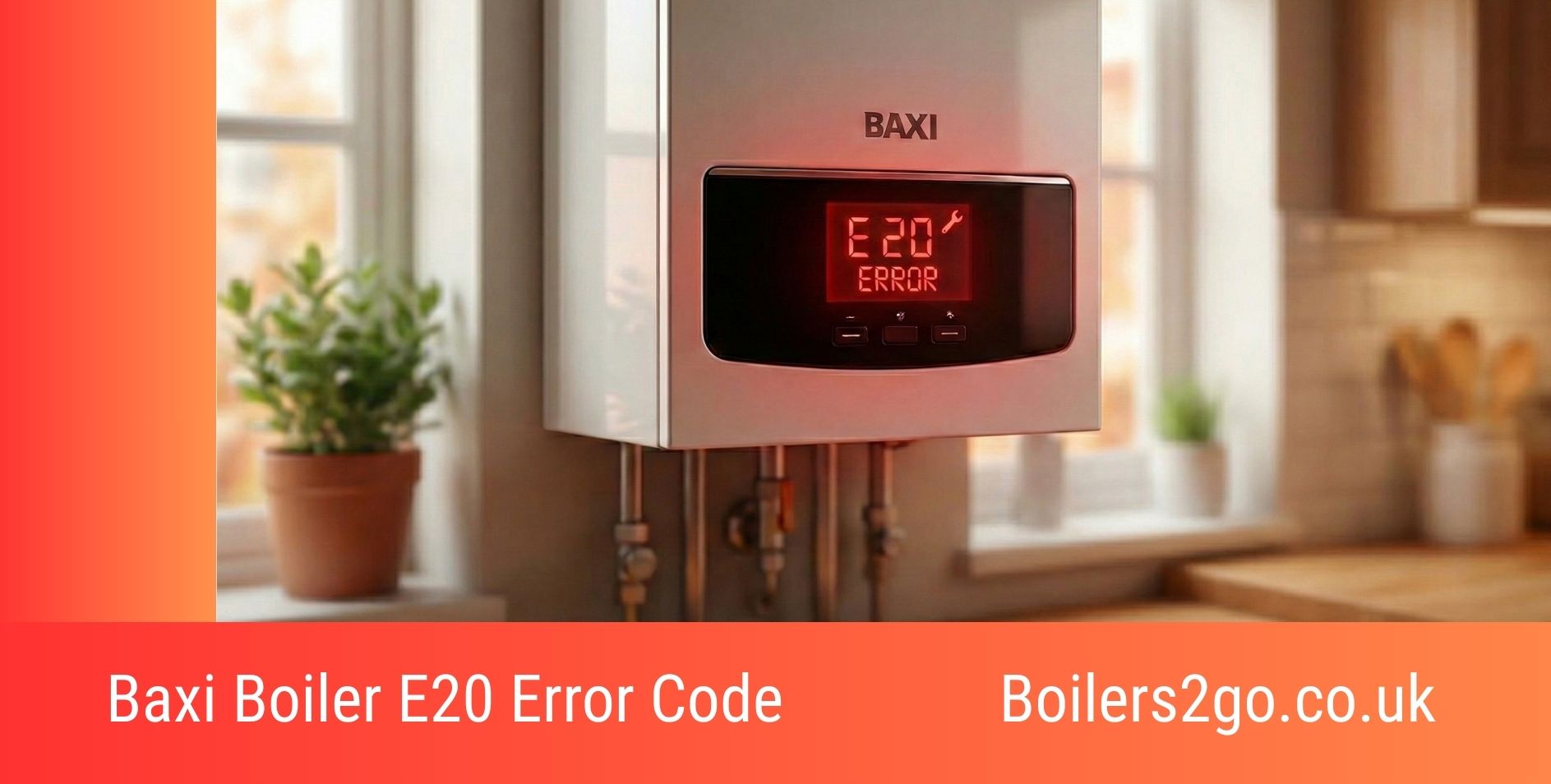
The E20 error code on a Baxi boiler indicates a fault with the central heating NTC thermistor, the temperature sensor that monitors the flow pipe temperature. When this sensor fails, sends an out-of-range reading, or loses its connection to the PCB, the boiler shuts down as a safety measure rather than risk running at an incorrect temperature.
Get a boiler cover, repair and annual service plan online here >
E20 is one of the most commonly reported Baxi fault codes across the Duo-Tec, Luna, Platinum, 600, and 800 series ranges. The good news is that it is one of the more diagnosable faults: there are only a handful of causes, and a Gas Safe engineer with a multimeter can usually identify the exact issue quickly.
For other faults across the range, see our full guide to Baxi boiler error codes.
Get a quote today and take the stress out of replacing your boiler. At Boilers2Go, we offer fast, reliable installation across the UK - often as soon as the next day. 
Need a new boiler?
What Does the Baxi E20 Error Code Mean?
E20 is Baxi’s official code for a central heating thermistor sensor fault. The NTC thermistor is a small resistive component clipped to the flow pipe inside the boiler. It works by changing its electrical resistance in response to temperature: as the water heats up, the resistance drops. The PCB reads this resistance and uses it to determine the flow temperature.
When the PCB receives a resistance reading that is outside the expected range, either too high (suggesting a very cold pipe), too low (suggesting overheating), or completely absent (suggesting a broken wire or disconnected sensor), it logs E20 and locks out the boiler. This lockout prevents the boiler from running when it cannot verify the temperature of the water it is heating.
The Baxi reset procedure for E20 is to turn the selector switch to the ‘R’ (Reset) position and hold for 5 seconds, then release. On push-button models, press and hold the reset button for 3 to 5 seconds. Attempt one reset only. If E20 returns immediately, the underlying fault is still present and must be resolved before resetting again.
Related Baxi Fault Codes
E20 is one of several NTC thermistor-related codes on Baxi boilers. Understanding how they relate helps both with diagnosis and with knowing which guides to consult alongside this one.
| Code | Fault | Relationship to E20 |
|---|---|---|
| E20 | Central heating NTC thermistor fault | Flow pipe temperature sensor: this article |
| E28 | Flue NTC thermistor or air pressure switch fault | Different sensor (flue), but same NTC technology; can be misdiagnosed as E20 |
| E50 | Domestic hot water NTC thermistor fault | DHW sensor — related fault on a different circuit |
| E110 | Overheat lockout | A failing NTC thermistor (E20) can cause apparent overheating readings leading to E110 |
| E1 | Overheat or water flow fault | Can appear alongside E20 if the boiler is unable to operate safely due to temperature fault |
Our Baxi E50 error code guide covers the domestic hot water NTC sensor fault, while the Baxi E110 error code guide explains the overheat lockout and when a thermistor fault is the contributing cause.
Get a quote today and take the stress out of replacing your boiler. At Boilers2Go, we offer fast, reliable installation across the UK - often as soon as the next day.
Need a new boiler?
Common Causes of the Baxi E20 Error Code
1. Faulty NTC Thermistor
The thermistor is the most frequent direct cause of E20. The component degrades over time through repeated heating and cooling cycles, moisture exposure, and corrosion on the metal probe that contacts the pipe. When the thermistor fails it either returns a reading that is completely outside the expected range, or it returns an open circuit (infinite resistance) if the internal element has broken entirely.
A Gas Safe engineer tests the thermistor by unplugging it and measuring resistance with a multimeter. At room temperature (approximately 20 degrees Celsius), a functioning Baxi central heating NTC thermistor should read approximately 10 to 12 kilohms. A reading well outside this range, or no reading at all, confirms the thermistor has failed.
What a Gas Safe Engineer Will Do
- Isolate power and gas to the boiler before accessing internal components.
- Locate the NTC thermistor on the central heating flow pipe inside the boiler (usually a small cylindrical probe clipped into a pocket in the pipe).
- Disconnect the sensor and test resistance with a multimeter at room temperature. Compare to Baxi’s specification for the model.
- If the resistance is outside the specified range, replace the thermistor with a compatible Baxi-approved part. Reconnect the wiring, repressurise if needed, and reset the boiler.
Thermistor replacement on a Baxi boiler typically costs £100 to £200 including parts and labour.
2. Wiring or Connection Fault
The thermistor connects to the PCB via a wiring loom. If any part of that circuit is broken, corroded, or intermittently disconnecting, the PCB receives erratic or absent resistance readings and flags E20. Wiring issues can produce the same symptom as a failed thermistor, which is why a Gas Safe engineer tests both the component and the wiring before replacing parts.
Vibration over years of operation can loosen the connector at the thermistor terminal or at the PCB. Boilers in humid environments, in damp utility rooms, or those with a small internal condensate leak that accumulates over time are more prone to corrosion at wiring terminals. On the Baxi Duo-Tec range in particular, loose thermistor connectors following earlier repairs are a documented cause of recurring E20 faults.
What You Can Safely Check
- With the boiler isolated at the fused spur, visually inspect the wiring harness between the flow pipe sensor and the control board for obvious damage: fraying, kinks, or burn marks.
- Gently press the connector at the thermistor terminal to confirm it is fully seated. Loose connectors sometimes reseat with light pressure and clear the fault after reset.
- Do not clean, cut, or reconnect wiring without Gas Safe registration. If there is visible damage, call an engineer.
Wiring inspection and repair by a Gas Safe engineer typically costs £100 to £200 depending on the extent of the work.
3. Low System Pressure
Low system pressure is an indirect cause of E20. When pressure drops significantly, the volume of water circulating through the boiler decreases. In extreme cases, water flow through the heat exchanger slows or stalls. Without adequate flow, the thermistor registers a rapidly rising temperature on the flow pipe, which can produce an out-of-range reading that the PCB logs as a thermistor fault rather than a circulation fault.
This is a straightforward check and the only E20-related fix that is safe to attempt as a DIY step before calling an engineer.
How to Check and Fix Low Pressure
- Check the pressure gauge on the front of the boiler. It should read between 1.0 and 1.5 bar when the system is cold. If it reads below 1.0 bar, the system needs topping up.
- Locate the filling loop (usually a flexible braided hose beneath the boiler with a valve at each end). Open both valves slowly and watch the gauge. Close them once it reaches 1.2 bar.
- Attempt a single reset. If E20 does not return, low pressure was the contributing cause.
- If pressure drops again within a few days, there is a leak somewhere in the system that needs a Gas Safe engineer to locate and repair.
4. Sludge or Limescale Build-Up
Magnetite sludge (the black metallic debris produced by corrosion inside radiators and pipework) and limescale from hard water can both affect thermistor operation. Limescale can coat the metal probe of the thermistor and insulate it from the pipe temperature, causing it to read lower than the actual water temperature. Sludge in the pipework can partially restrict flow, creating the same low-circulation conditions described under the pressure cause above.
E20 caused by sludge or limescale is more common in properties that have never had a magnetic filter fitted, that have not been serviced for two or more years, or that are in hard water areas such as the South East and East of England. If E1 is also appearing on the same boiler, read our Baxi E1 error code guide alongside this one, as sludge-related flow restriction can trigger several fault codes at once.
What a Gas Safe Engineer Will Do
- Add a chemical cleaner (such as Fernox F3 or Sentinel X400) to the system, circulate for the recommended period, then drain and flush thoroughly.
- For moderate to heavy sludge, carry out a powerflush: a high-pressure cleaning agent is circulated through the system to break down and flush out deposits. Typical cost is £400 to £600 depending on system size.
- Install a magnetic filter on the return pipe and dose with a corrosion inhibitor to prevent recontamination.
5. PCB (Printed Circuit Board) Fault
In a small proportion of E20 faults, the issue is not with the thermistor or its wiring but with the PCB itself. If the PCB’s input circuit for the thermistor signal is damaged or malfunctioning, it may generate E20 regardless of the thermistor’s actual condition. This is confirmed by testing: if the thermistor reads correctly on a multimeter but E20 persists after reconnecting it, the PCB is the likely next suspect.
Power surges are a common cause of PCB component damage on UK domestic boilers. Water ingress from an internal leak reaching the board is another frequent cause. PCB faults are the most expensive E20 repair: replacement typically costs £300 to £500 including parts and labour on Baxi models. For boilers over 10 to 12 years old, this cost level makes a replacement boiler quote worth obtaining before authorising the repair.
How to Reset the E20 Fault on a Baxi Boiler
Attempt a reset only after carrying out the pressure check above. If pressure is correct and E20 returns immediately after reset, call a Gas Safe engineer. Do not reset more than once without addressing the underlying fault.
- Duo-Tec, Luna, Platinum, and 600/800 series: turn the selector switch to the ‘R’ position and hold for 5 seconds, then release back to your normal setting. The display should clear and the boiler will attempt to restart.
- Baxi 200 and 400 series: press and hold the reset button on the front panel for 3 to 5 seconds.
- If the E20 code reappears after the boiler fires up, the fault is still active. Stop resetting and call a Gas Safe engineer.
How to Prevent the Baxi E20 Fault
- Annual Gas Safe service: this is the most effective prevention. A full service includes testing the thermistor resistance and inspecting wiring connections, which catches degrading sensors before they fail entirely. Annual servicing is also required to keep most Baxi warranties valid.
- Fit a magnetic filter: a Magnaclean or Fernox TF1 on the return pipe captures magnetite debris before it reaches the boiler, slowing the rate at which sludge accumulates near the thermistor and heat exchanger.
- Dose with corrosion inhibitor annually: standard practice at any Gas Safe service, but worth confirming was done if the service record does not specifically note it.
- Fit a surge protector on the fused spur: power surges are a known cause of PCB damage that can lead to false E20 codes. A surge protector available from any electrical merchant significantly reduces this risk.
- In hard water areas: fit a scale reducer on the cold mains inlet to reduce limescale build-up on the thermistor probe and heat exchanger surfaces.
When Should You Get a New Baxi Boiler Quote?
For Baxi boilers under 10 years old, replacing the NTC thermistor or repairing the wiring is almost always the right economic decision. The repair cost is low relative to the remaining boiler life. For boilers over 12 years old where E20 is accompanied by other recurring faults, or where the repair requires a PCB replacement, the total repair cost can approach or exceed the value of the boiler.
Boilers 2 Go provides free, no-obligation new boiler quotes with fast installation across the UK, often available the next day. If you are weighing up repair costs against replacement, request a quote and we will help you compare the two options side by side.
Baxi E20 Error Code: FAQs
Can the Baxi E20 Code Be Caused by Something Other Than the Thermistor?
Yes. Low system pressure reducing circulation, sludge build-up insulating the sensor probe, wiring faults interrupting the signal, and PCB damage misreading the sensor can all produce E20. A Gas Safe engineer tests the thermistor first with a multimeter because it is the most common cause, but will then work through the wiring, pressure, and PCB if the thermistor reads correctly.
How Does Hard Water Increase the Risk of Baxi E20 Faults?
In hard water areas, calcium carbonate (limescale) deposits on the metal probe of the NTC thermistor over time. The scale layer insulates the probe from direct contact with the water temperature, causing it to read lower than the actual temperature. The PCB detects the discrepancy between the expected and actual readings and logs E20. Fitting a scale reducer on the mains inlet significantly slows this process. Areas particularly affected include London, the South East, East Anglia, and parts of the Midlands.
Is the Baxi E20 Fault Dangerous?
E20 is not a gas emergency and does not indicate a risk of gas leak or carbon monoxide. The boiler has locked itself out as a precaution because it cannot verify the flow temperature, and running with an inaccurate temperature sensor risks either overheating the heat exchanger or running inefficiently. The lockout is the correct response. Do not attempt to override it by repeatedly resetting: this forces the boiler to operate in a state it has identified as potentially unsafe.
What If the Baxi E20 Code Returns After Thermistor Replacement?
If E20 persists after a new thermistor has been fitted, the most likely remaining causes are a wiring fault (loose, corroded, or damaged connections between the thermistor and PCB), an incorrectly positioned new sensor that is not making proper contact with the pipe pocket, or a PCB fault that is misreading the sensor signal. A Gas Safe engineer can systematically test each of these with a multimeter. It is relatively uncommon for a second component to fail simultaneously, so a wiring check should always precede a PCB replacement diagnosis.
How Much Does It Cost to Repair a Baxi E20 Fault in 2026?
A thermistor replacement is typically £100 to £200 including parts and labour. Wiring repair is in a similar range at £100 to £200. A powerflush for sludge removal costs £400 to £600. A PCB replacement is £300 to £500. These are approximate 2026 UK figures and will vary by engineer and region. To weigh the repair against the cost of a new boiler, see current prices in our Baxi boiler reviews.
Get a quote today and take the stress out of replacing your boiler. At Boilers2Go, we offer fast, reliable installation across the UK - often as soon as the next day.
Need a new boiler?

I’m Penny North, a home energy heating expert. My mission is to demystify new boilers and complex heating systems to help you achieve a warm, cosy home with lower energy bills and a smaller environmental footprint.