

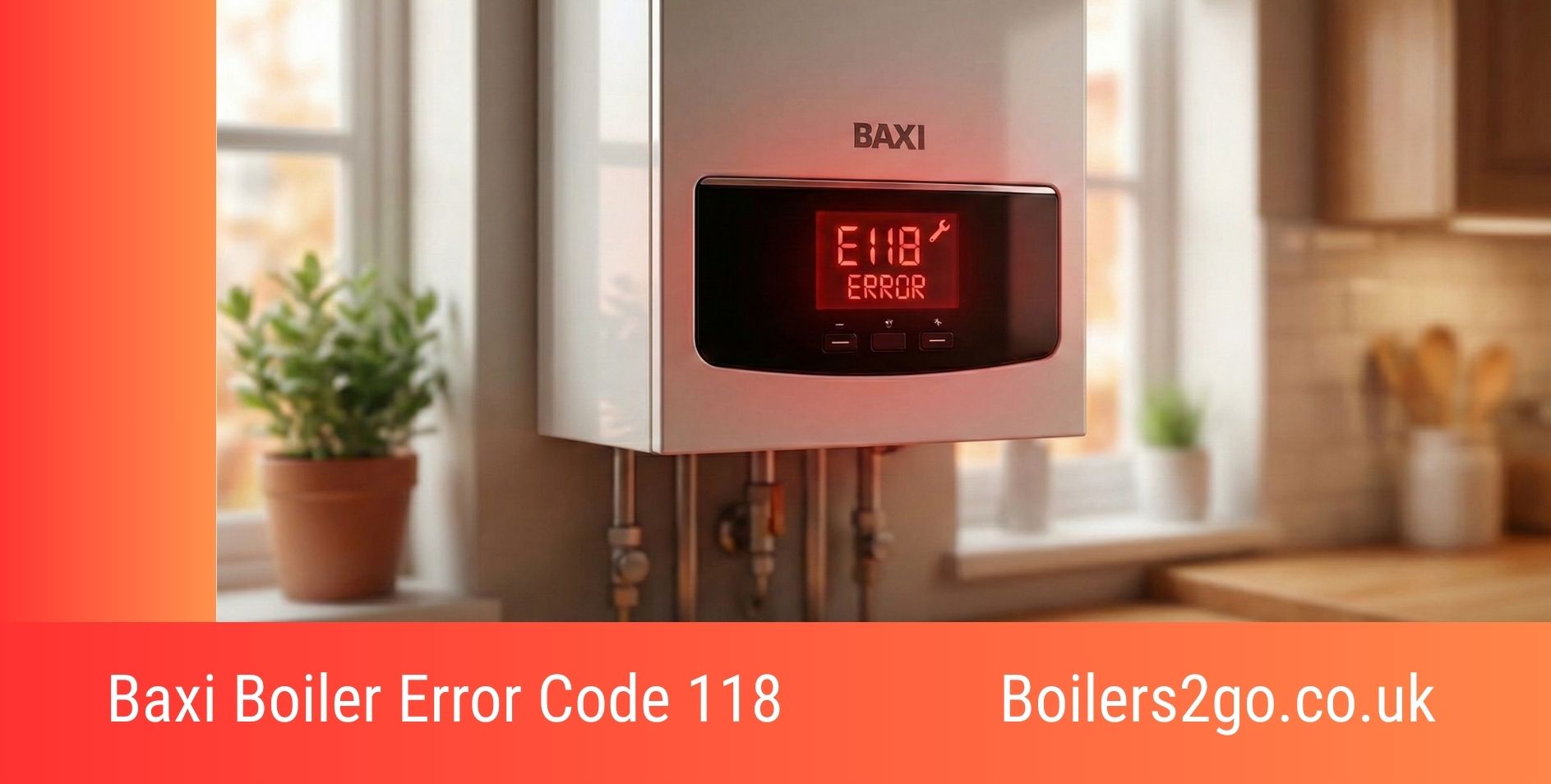
The Baxi error code 118 is one of the most common faults reported by Baxi boiler owners across the UK, and the good news is that it is also one of the more straightforward to understand. It is a low water pressure warning: your boiler has detected that pressure has dropped below the safe operating threshold and has shut itself down to avoid running dry and damaging internal components.
You will most likely see it displayed as E118 on the front panel, often alongside a pressure gauge reading well below 1.0 bar. Cold radiators, lukewarm taps, and a boiler that refuses to ignite are the usual signs that this fault is active.
This guide explains what causes the pressure drop, what you can safely fix yourself, and when to call a Gas Safe registered engineer. For the wider range of Baxi faults, see our full guide to Baxi boiler error codes.
Baxi Error Code 118: Video Guide
What Does the Baxi Boiler Error Code 118 Mean?
Error code 118 (also shown as E118) means the water pressure in your sealed heating circuit has dropped below approximately 0.5 to 1.0 bar, depending on the model. At that level, the boiler cannot circulate water safely and triggers a protective lockout to prevent damage to the heat exchanger and pump. If the pressure is fine but water still isn’t moving through the boiler properly, you are more likely to see Baxi error code 125, which points to a circulation fault.
A healthy Baxi boiler should maintain pressure between 1.0 and 1.5 bar when the system is cold. Once it drops below that range, performance suffers. Below 0.5 bar, most Baxi models including the 600 and 800 series will lock out entirely and display the 118 or E118 code.
The boiler will not restart until pressure is restored to a safe level. Simply pressing reset without topping up the system first will not clear the fault.
Signs You Are Dealing With Baxi Error Code 118
- The display panel shows 118 or E118, sometimes flashing
- The pressure gauge reads below 1.0 bar, often in the red zone
- Radiators are cold or only partially warming
- Taps are producing lukewarm water or no hot water at all
- The boiler fires briefly then cuts out, or will not ignite at all
- Some models show an additional low pressure warning light on the panel
What Causes the Baxi Boiler Error Code 118?
The 118 fault is always triggered by insufficient water in the sealed heating circuit. The table below summarises the main causes at a glance before each one is covered in detail.
| Cause | How Pressure Drops | DIY or Engineer? |
|---|---|---|
| System leak | Water escapes slowly from joints or valves | Engineer if hidden; DIY visible minor drips |
| Radiator bleeding | Air released takes water with it | DIY: repressurise via filling loop |
| Faulty pressure relief valve | Valve discharges water unnecessarily | Engineer: replace valve |
| Expansion vessel fault | Vessel cannot absorb pressure changes | Engineer: recharge or replace vessel |
| Natural evaporation/loss | Gradual micro-losses over months | DIY: top up; engineer if recurring |
| Faulty pressure sensor | False low reading despite adequate water | Engineer: clean or replace sensor |
System Leaks
A slow leak somewhere in the heating circuit is the most common cause of the 118 fault. Water escapes gradually from corroded pipework, loose radiator valve connections, or failing seals at boiler joints. Because the loss is slow, many homeowners do not notice it until the pressure has already dropped far enough to trigger a lockout.
Older properties with copper pipework are more susceptible to pinhole leaks and corrosion at soldered joints. Some leaks occur inside walls or under floors where they are not visible without specialist equipment.
How to Fix System Leaks
- Check all visible pipework, radiator valves, and boiler connections for damp patches, rust staining, or drips. A dry piece of tissue pressed against joints can help reveal very slow seeps.
- Gently tighten any loose connections with a spanner. Do not over-tighten, particularly on older copper fittings, as this can crack the joint.
- Repressurise the system to 1.2 bar via the filling loop and reset the boiler.
- Monitor the pressure gauge over the next few days. If it drops again quickly (within 24 to 48 hours), there is an active leak that needs tracing. Do not keep topping up: call a Gas Safe engineer to locate and repair it.
Professional leak detection typically costs between £100 and £300 including parts such as replacement seals, depending on how accessible the leak is.
Recent Radiator Bleeding
Bleeding a radiator releases trapped air from the system, but some water comes out with it. If you have bled several radiators without topping up the pressure afterwards, a 118 fault is the likely result. This is one of the easiest causes to fix yourself.
How to Fix It After Radiator Bleeding
- Confirm the pressure gauge is reading below 1.0 bar.
- Locate the filling loop, usually a flexible braided hose beneath the boiler with two valves. Open both valves slowly and allow water to enter the system.
- Watch the gauge and close both valves once it reaches 1.2 bar. Do not overfill: going above 2.0 bar can trigger the pressure relief valve to discharge.
- Reset the boiler and run a full heating cycle to confirm even warmth across all radiators.
- Consider adding a corrosion inhibitor to the system water if this has not been done recently. This reduces future air formation and debris build-up.
Faulty Pressure Relief Valve
The pressure relief valve (PRV) is a safety device that opens to release water if pressure climbs too high, typically above 3 bar. When the valve wears out or debris holds it slightly open, it can discharge water continuously even at normal operating pressures, causing a slow but steady pressure drop.
A tell-tale sign of a weeping PRV is a damp patch or steady drip from the external discharge pipe, which exits through an outside wall or terminates above a drain.
How to Fix a Faulty Pressure Relief Valve
- Check the discharge pipe outside the property. A drip when the boiler is running and has not been overpressurised usually points to a failing valve.
- Repressurise and reset to see whether the dripping stops. If it continues, the valve is not seating correctly.
- Isolate the boiler and call a Gas Safe engineer to replace the valve. Replacement typically costs £150 to £250 including parts and labour.
- After replacement, monitor pressure for several days to confirm the loss has stopped.
Expansion Vessel Fault
The expansion vessel absorbs the increase in water volume that occurs as the system heats up. If the vessel loses its charge pressure or the internal diaphragm fails, it cannot perform this function. The result is pressure swings: the PRV may discharge at high temperatures, leaving the system low on water when it cools.
This fault is often overlooked because the system appears to hold pressure when cold but loses it repeatedly after a heating cycle. If that pattern applies to your boiler, the expansion vessel is worth checking.
How to Fix an Expansion Vessel Fault
- This is not a DIY repair. A Gas Safe engineer can test the vessel’s charge pressure using a simple gauge. If it has lost pressure, re-gassing the vessel may be possible.
- If the internal diaphragm has failed, the vessel will need replacing. This is a common repair on boilers over 8 to 10 years old.
- Typical cost for expansion vessel repair or replacement is £150 to £300 including labour.
Evaporation and Natural Pressure Loss
Over many months, sealed systems can lose very small amounts of water through micro-pores in seals and fittings. This gradual loss is normal to a degree, but if your boiler needs topping up more than once or twice a year, it suggests there is a contributing fault beyond natural evaporation.
How to Fix Natural Pressure Loss
- Top up to 1.2 bar via the filling loop and reset the boiler.
- Note the date and monitor weekly. A healthy sealed system should hold pressure for months between top-ups.
- If pressure drops monthly or more frequently, add a system sealant such as Fernox F4 to plug micro-leaks. This should be done alongside, not instead of, investigating any underlying fault.
- At the next annual service, ask the engineer to check seal condition and expansion vessel charge.
Faulty Pressure Sensor
Occasionally the 118 fault is triggered not by an actual pressure drop, but by a failing pressure sensor that is sending an inaccurate reading to the PCB. The boiler acts on the false reading and locks out, even though the system actually contains adequate water.
This is less common than a genuine pressure loss, but it is worth suspecting if the gauge appears normal and you cannot find any source of water loss. Scale build-up around the sensor or a loose wiring connection are the usual culprits.
How to Fix a Faulty Pressure Sensor
- Repressurise to 1.2 bar and reset. If the code clears and holds, a momentary sensor glitch may have been the cause.
- If the 118 code returns despite the gauge showing an adequate reading, contact a Gas Safe engineer. They can verify actual pressure using an independent gauge and test the sensor’s output.
- Sensor cleaning or replacement typically costs £150 to £300 including parts. A system flush may also be recommended to remove scale that could be affecting the sensor.
How to Repressurise a Baxi Boiler: Quick Steps
Most 118 faults can be cleared with a straightforward pressure top-up. Here is the process that applies to most Baxi combi and system boiler models.
- Turn the boiler off at the controls and allow it to cool for around 10 minutes.
- Locate the filling loop. On most Baxi models this is a flexible braided hose beneath the boiler with a valve at each end, or sometimes a keyless filling link. Refer to your user manual if you cannot find it.
- Open both filling loop valves slowly. You should hear water entering the system.
- Watch the pressure gauge and close both valves as soon as it reaches 1.2 bar. Do not exceed 1.5 bar.
- Turn the boiler back on. The 118 code should clear automatically once pressure is within range.
- If the code does not clear, press the reset button once and wait for the boiler to complete its start-up sequence.
If pressure drops again within a day or two, stop topping up and call a Gas Safe engineer. Repeated repressurising masks the underlying fault and can allow a slow leak to cause greater damage over time.
Should You Replace a Baxi Boiler Showing Error 118?
Most 118 faults are a repair job, not a reason to replace the boiler. That said, if your Baxi is over 10 to 12 years old and the 118 fault is appearing alongside other recurring issues, the economics of ongoing repairs can shift in favour of a replacement.
A modern condensing combi boiler is considerably more energy efficient than a unit from a decade ago. Our Baxi boiler reviews cover how current models compare on efficiency and running costs.
Get in touch with the Boilers 2 Go team for a replacement boiler quote. We cover installations across the UK, often available the next day.
Baxi Boiler Error Code 118: FAQs
How Does Seasonal Maintenance Prevent Baxi Error Code 118?
A pre-winter check by a Gas Safe engineer includes a full pressure test, visual inspection for leaks, and a check of the expansion vessel charge. Catching a small pressure drop or a weeping valve before the heating season starts means you are less likely to face a 118 lockout on a cold January morning when demand on the boiler is at its highest.
What Accessories Help Monitor Baxi Boiler Pressure Remotely?
Smart thermostats with boiler monitoring functionality, such as Hive and Nest, can alert you to heating system irregularities that may indicate pressure loss. Some third-party smart pressure gauges can also be added to the system to send notifications if pressure drops below a set threshold. This is particularly useful for landlords who cannot check the boiler in person regularly.
Are There UK Incentives for Replacing a Faulty Baxi Boiler?
The UK government’s ECO4 scheme (Energy Company Obligation) runs until 31 December 2026 and can fund boiler replacements and heating improvements for eligible low-income households. If your Baxi is old, inefficient, and generating frequent fault codes, it is worth checking eligibility via your energy supplier. Some local councils also offer support through the Warm Homes: Local Grant.
How Do Pipe Materials Affect Baxi Error Code 118?
Older copper pipework is more prone to pinhole corrosion and joint failure over time, particularly in areas with aggressive water chemistry or where the system has never been treated with inhibitor. Modern plastic (PEX or polybutylene) pipework is more resistant to corrosion, though it is not immune to joint failures at compression fittings. If your property has a mix of old copper and newer plastic pipework, the joints between the two materials are worth checking first.
Can System Sealants Stop Recurring Baxi 118 Codes?
System sealants such as Fernox F4 or Sentinel X100 can plug very small leaks and reduce micro-losses, which may extend the time between top-ups. They are not a substitute for fixing a genuine leak: if your system is losing pressure quickly, a sealant will not hold it. Used as a preventive measure during annual servicing, alongside a corrosion inhibitor, they do help reduce the frequency of pressure-related faults in well-maintained systems.
Is the 118 Fault the Same as the 117 Fault on Baxi Boilers?
No, they are opposite pressure faults. On current Baxi boilers, error 117 means system pressure is too high (typically above about 2.7 bar), while error 118 means pressure is too low for the boiler to run safely. Our guide to the Baxi 117 error code explains how to bring high pressure back down safely.

I’m Penny North, a home energy heating expert. My mission is to demystify new boilers and complex heating systems to help you achieve a warm, cosy home with lower energy bills and a smaller environmental footprint.