

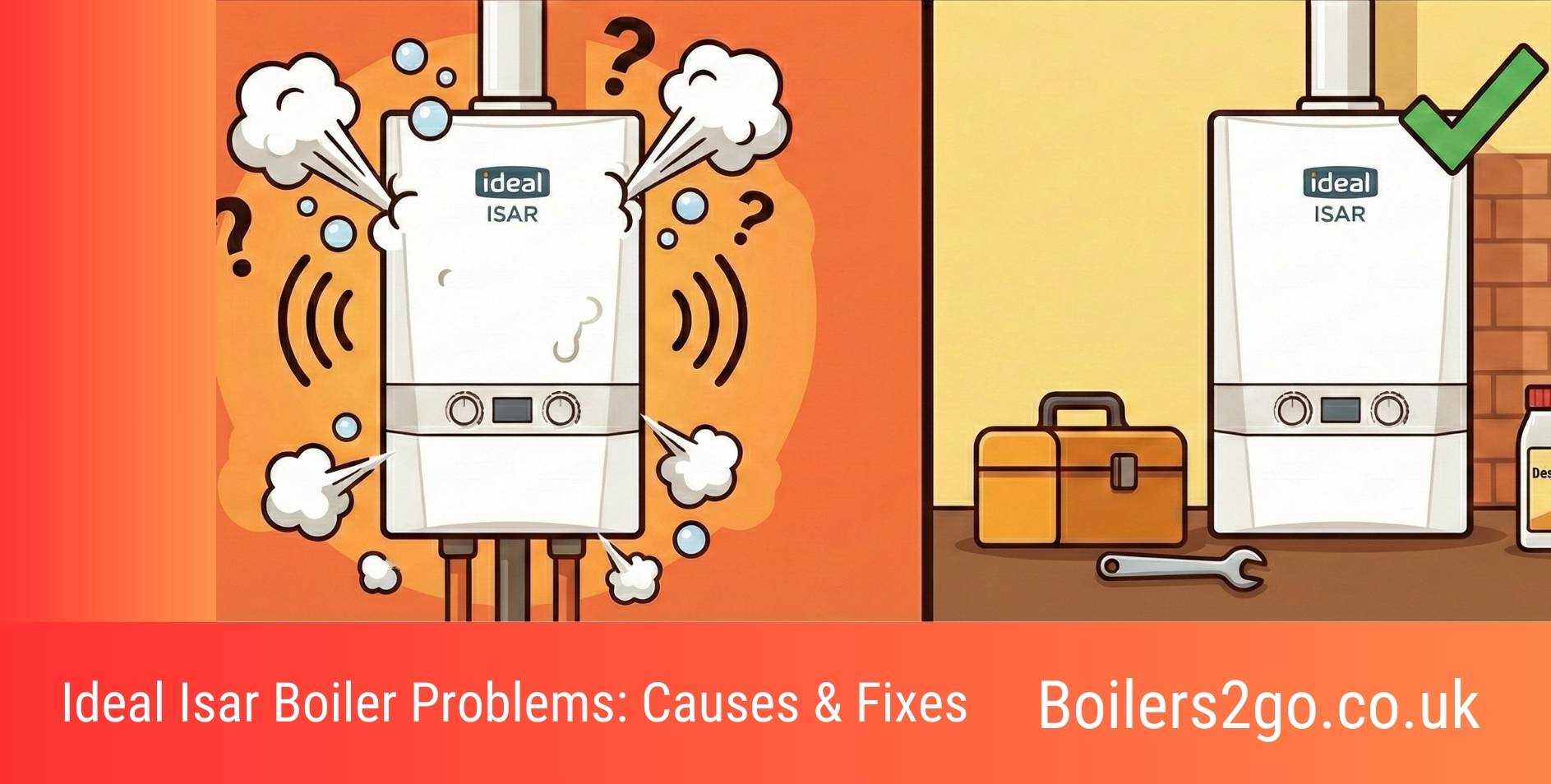
The Ideal Isar, while a popular model in its time, has a few characteristic faults that can disrupt central heating and hot water supply. Many issues have straightforward solutions, though some will absolutely require a Gas Safe registered engineer.
Get a boiler cover, repair and annual service plan online here >
This guide covers how to identify the issue, understand the cause, and know the next best step for restoring reliable heating.
Need a new boiler?
Get a quote today and take the stress out of replacing your boiler. At Boilers2Go, we offer fast, reliable installation across the UK - often as soon as the next day.
Get Installation QuoteMost Common Ideal Isar Boiler Problems That Cause a Complete System Failure
The most common Ideal Isar boiler problems that lead to a complete system failure, leaving no heating or hot water, often stem from issues with the boiler’s central electronic brain, the Printed Circuit Board (PCB), or a loss of flame detection.
A blank display, a completely dead boiler, or an error code of L-F or F2 (Flame Loss/Ignition Lockout) are all classic signs of a serious underlying issue.
1. PCB Failure (Dead Boiler)
The PCB is effectively the brain of the boiler unit. When it fails, often due to a transformer burning out, the Ideal Isar will not work at all. This is a significant, system-stopping fault.
What to do: call a Gas Safe engineer immediately, since this is a safety-critical electrical fault. Replacing this component can be expensive, and for an older model like the Isar, it often triggers the difficult repair-or-replace decision.
2. Ignition Lockout (L-F / F2)
Flame loss issues, signified by codes such as L-F or F2, mean the boiler is failing to ignite the gas or cannot detect the flame, a crucial safety feature that locks the boiler down. This failure often happens because the ignition components are fouled by deposits or dirt.
What to do: try a simple boiler reset first. If the problem recurs, a Gas Safe engineer will need to clean the electrode or probe.
3. Condensate Trap Blockage (L-2)
Explosive ignition noises followed by a lockout code such as L-2 (Flame Loss Lockout) often point to a blocked condensate trap. The trap becomes blocked by sludge or debris, preventing the boiler from disposing of waste water correctly.
What to do: this is also a safety concern, and a Gas Safe engineer must clear the blockage.
Why Does an Ideal Isar Boiler Keep Losing Pressure (F1 Fault Code)?
Ideal Isar boiler problems that include frequently losing pressure, often shown as the F1 fault code, signal that the water pressure in the central heating system has dropped below the minimum operational threshold, usually below 1.0 bar. Low water pressure is the most common reason for a boiler lockout. Checking for any leaks in the heating system is the first step, since this can significantly affect pressure levels. Our Ideal boiler F1 fault code guide covers the causes in more detail.
This is often the easiest problem for a homeowner or landlord to resolve independently. Check the pressure gauge, either a physical dial or a digital reading on the control panel, when the system is cold. It should ideally read between 1.0 and 1.5 bar.
How to Repressurise an Ideal Isar Boiler
- Turn off the boiler power.
- Locate the filling loop, a flexible metallic hose with two isolation valves underneath the boiler.
- Slowly open both valves until water can be heard entering the system.
- Monitor the pressure gauge until it reaches 1.2 to 1.5 bar.
- Close both valves firmly and, if detachable, remove the filling loop.
- Switch the boiler power back on and press the reset button to clear the F1 code.
Needing to repressurise the boiler more than a couple of times a year points to a leak somewhere in the heating system, which will need a professional to trace.
How to Fix a Frozen Condensate Pipe on an Ideal Isar
When UK temperatures drop sharply, a common issue with high-efficiency condensing boilers, including the Ideal Isar, is a frozen condensate pipe. This narrow waste pipe, not the main flue, runs from the boiler to an outside drain.
If the water inside freezes, the boiler cannot safely dispose of the acidic wastewater and locks out as a safety precaution. This is often accompanied by gurgling noises or, sometimes, a lockout code such as L2.
How to Thaw an Ideal Isar Condensate Pipe
- Locate the blockage. It is usually the external part of the pipe or the elbow joint just outside the wall.
- Use warm, not boiling, water to thaw the pipe. Pour it from a kettle or jug, or wrap a hot water bottle or microwavable heat pack around the frozen section.
- Once the pipe is clear, the boiler should automatically reset or allow a manual reset.
Insulating, or lagging, the exposed pipework with foam insulation from any DIY store is a straightforward way to prevent this winter fault recurring.
Why Is an Ideal Isar Combi Boiler Giving No Hot Water But the Heating Is Working?
A frustrating issue specific to combi boilers like the Ideal Isar is having central heating but no hot water, or the reverse. This classic symptom often points to a failure of the diverter valve, a vital component that directs hot water either to the radiators or to the taps.
On older boilers, especially the Isar combi model, the valve can get stuck or fail due to internal wear and tear or a build-up of sludge or limescale. Radiators getting warm even when there is no demand for central heating also suggests a partially failed diverter valve, with hot water slipping into the central heating circuit.
What to do: this is not a DIY fix, since the diverter valve is an internal boiler component. A Gas Safe registered heating engineer will need to diagnose the problem and will likely need to replace the valve.
Are Strange Noises From an Ideal Isar a Sign of Serious Problems?
Yes, strange noises from a boiler should always be taken seriously, since they indicate internal issues that need attention, whether that is kettling, banging, or gurgling sounds. These noises are often indicators of deeper Ideal Isar boiler problems related to circulation and water quality.
1. Kettling (Like a Boiling Kettle)
This indicates limescale or sludge build-up on the heat exchanger, a high severity issue. The build-up stops the heat exchanger working effectively, forcing the boiler to overwork and overheat, which can significantly shorten its lifespan and increase home heating costs.
What to do: call an engineer. This will likely require a powerflush or chemical clean to remove the build-up.
2. Gurgling or Bubbling
This usually suggests air trapped in the central heating system or, sometimes, a condensate pipe blockage, generally a medium severity issue. On newer Ideal Logic boilers, the same circulation problems can cause a no-flow lockout, which is explained in our guide to the Ideal Logic boiler FD fault code.
What to do: try bleeding the radiators and checking the condensate pipe for freezing. If the noise persists, call an engineer.
3. Banging or Explosion on Ignition
This is caused by ignition failure resulting in a delayed, explosive light-up of the gas, a high severity fault with the gas or ignition system.
What to do: call a Gas Safe engineer immediately.
Should You Replace Your Ideal Isar Boiler?
If your Ideal Isar is over 10 years old or keeps needing repairs, replacing it is likely to be the most cost-effective solution in the long run. Continual costly repairs, poor energy efficiency, and unreliable central heating can be a real headache for any homeowner or landlord. If you want to stay with the brand, our Ideal Logic Max combi boiler review covers one of its current models.
Anyone ready to upgrade can request a boiler replacement quote to compare fixed-price options fitted by a local, trusted engineer. Any installation should be carried out by an engineer listed on the Gas Safe Register, regardless of which brand or model is chosen. Upgrading typically brings an immediate improvement in energy efficiency, lower bills, and a long-term warranty for peace of mind.
Get a quote today and take the stress out of replacing your boiler. At Boilers2Go, we offer fast, reliable installation across the UK - often as soon as the next day.
Need a new boiler?
Ideal Isar Boiler Problems: FAQs
How Long Does an Ideal Isar Boiler Last?
The Ideal Isar range was robust for its time, with a typical effective lifespan of around 10 to 12 years. After this point, most homeowners and landlords should start considering a replacement.
The primary reason is that parts for older models become harder to source and more expensive, and the boiler’s efficiency, often around 85% or less, is significantly lower than a modern A-rated boiler at up to 94%, meaning an upgrade tends to save more on gas bills than repeated repairs on an ageing unit ever would.
Do You Need a Powerflush to Prevent Recurring Ideal Isar Problems?
Often, yes. A powerflush, the process of flushing chemical cleaning agents through the entire central heating system, is highly recommended for anyone experiencing recurring issues such as kettling, cold spots on radiators, or repeated diverter valve failures.
These symptoms are caused by a build-up of magnetite sludge and limescale within the pipework and heat exchanger. A powerflush cleans the system out, protecting new components, and is often a requirement to maintain the warranty on any newly installed parts, including a replacement heat exchanger.
What Does the L-A Error Code Mean on an Ideal Isar Boiler?
The L-A error code on an Ideal Isar boiler signifies an overheat lockout. This safety feature triggers when the boiler detects the water temperature is dangerously high. It is a serious fault that can be caused by low system pressure, poor water circulation due to a faulty pump or closed valves, or a problem with the main temperature sensors (thermistors). Troubleshooting usually begins with checking the system pressure and ensuring there are no obstructions in the water circuit; other codes are covered in our Ideal boiler error codes guide.
If the L-A code appears, check the system pressure first, ensure all radiator valves are open, and if it persists after a reset, call a Gas Safe engineer immediately.
Are Ideal Isar Spare Parts Still Available in the UK?
Only partly. Spares for some of the more common components, such as the gas valve or a pressure relief valve, may still be available, but availability for core parts such as the Printed Circuit Board or the heat exchanger is becoming increasingly limited and costly due to the model’s age.
This scarcity of crucial boiler parts is another significant factor pushing the repair-or-replace decision, since a lengthy wait for a spare part in the middle of winter is what every landlord and homeowner wants to avoid.
Should You Fit a Magnetic Filter to an Ideal Isar System?
Yes. A magnetic filter, such as a MagnaClean, is an excellent preventative measure for any central heating system, especially one connected to an Ideal Isar. These filters effectively capture the black iron oxide sludge that causes internal damage and corrosion within components such as the pump and heat exchanger.
While it will not fix existing damage, a filter protects any new replacement parts and significantly extends the boiler’s lifespan by keeping the system water clean, improving efficiency and reducing the likelihood of circulation-related problems.
Is It Worth Repairing an Ideal Isar After a PCB Failure?
This depends heavily on the boiler’s age and overall condition. If the Isar is otherwise in good order and under 10 years old, a PCB replacement can still make sense. Beyond that age, with rising part scarcity and cost, most engineers will recommend putting the money towards a new A-rated boiler instead, since a PCB replacement alone can approach a significant share of a full replacement cost on an older unit.
Can an Ideal Isar Be Fixed If the Same Fault Returns After a Reset?
Yes, but only once the underlying cause is found. A fault that returns immediately or repeatedly after a reset almost always means the cause has not actually been fixed, only masked temporarily. Repeated resetting can also stress the ignition components and PCB further, so it is best to stop resetting after two attempts and call a Gas Safe engineer for a proper diagnosis.
Get a quote today and take the stress out of replacing your boiler. At Boilers2Go, we offer fast, reliable installation across the UK - often as soon as the next day.
Need a new boiler?

I’m Penny North, a home energy heating expert. My mission is to demystify new boilers and complex heating systems to help you achieve a warm, cosy home with lower energy bills and a smaller environmental footprint.