

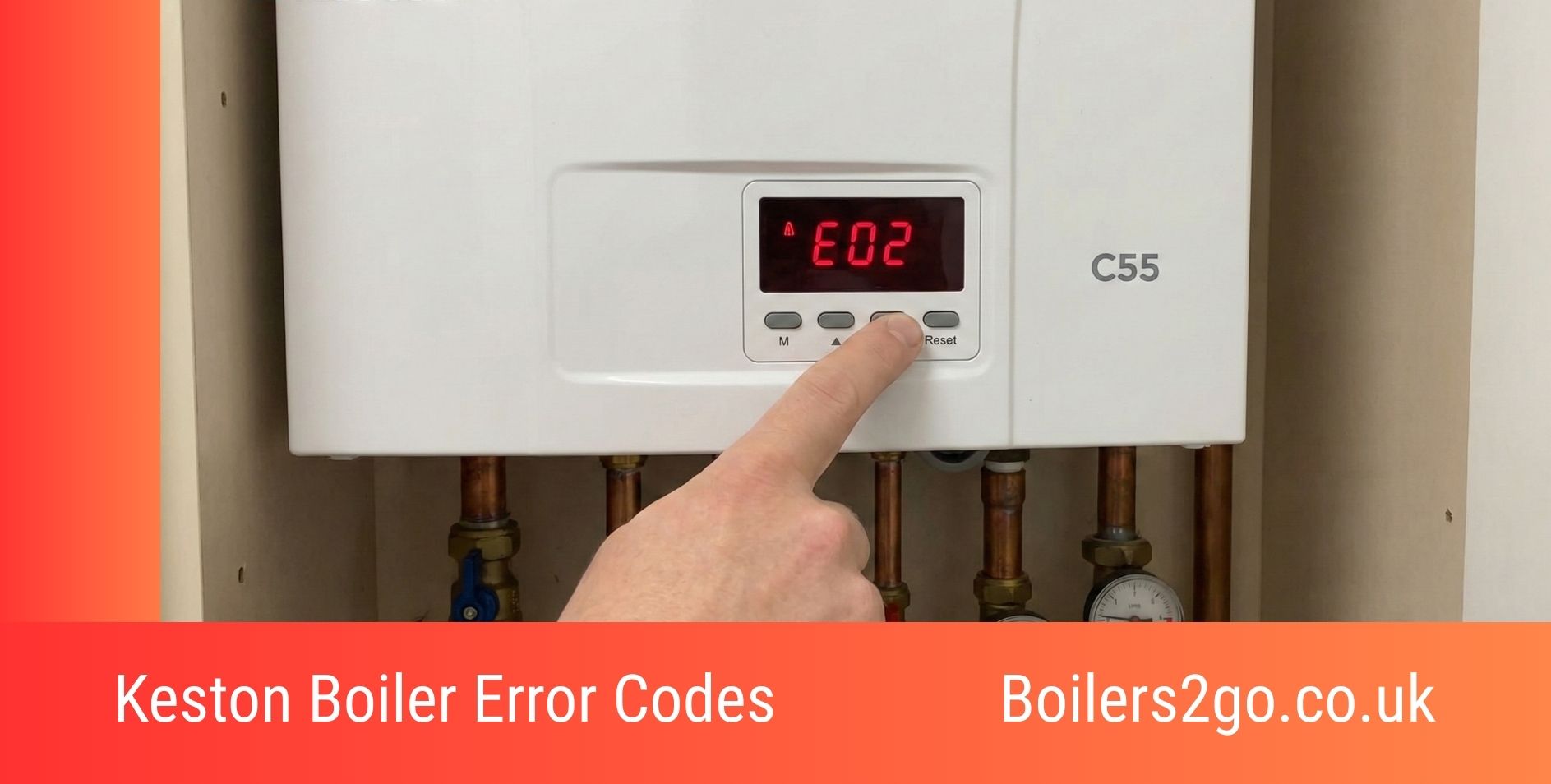
Keston boilers are not as widely installed as Worcester Bosch or Vaillant, but they are a fixture in thousands of UK properties, particularly new-build flats, urban apartments, and homes where a long or unusual flue run rules out a standard boiler. The twin-flue system that makes them so flexible in awkward installations is also what makes them a specialist appliance when something goes wrong.
Get a boiler cover, repair and annual service plan online here >
When a Keston displays an error code, most generic boiler fault websites offer little useful help because they simply do not cover the range. This guide is for UK homeowners and landlords staring at an E-number, L-number, or a flashing red light on a Keston right now. It covers what each code means, what you can safely do yourself, and when a Gas Safe engineer with Keston experience is the only right answer.
Keston has been part of the Ideal Heating group since 2006 and production moved to Ideal’s Hull facility in 2013. Parts and technical support remain available, though they are specialist items. Because the two brands share a parent group, fault diagnosis follows a similar approach, so our Ideal boiler error codes guide is a useful companion reference.
Get a quote today and take the stress out of replacing your boiler. At Boilers2Go, we offer fast, reliable installation across the UK - often as soon as the next day. 
Need a new boiler?
Keston Boiler Error Codes: Video Guide
How Keston Boilers Display Faults
Keston uses different display systems depending on the model and era of the boiler. Knowing which you have helps you interpret the fault correctly. If your boiler isn’t showing a code at all, our guide to common boiler problems is a better starting point.
- Modern Keston C35 / C40 / C40P (2018 onwards): large digital display shows E** or L** codes alongside sensor readings
- Keston Qudos 28 / QSpa: small LED screen with E-codes; the Qudos 28H also has an error history function that stores the last six faults with sensor readings at the time of each lockout
- Older twin-flue Keston Celsius / Combi models: display alternates between the flow temperature and the fault number, or simply shows flashing lights with no code
All Keston boilers lock out with a solid or flashing red light when a serious fault occurs. The boiler will not attempt to restart until the reset button (marked with a spanner symbol) is pressed. On the Qudos 28H, you can access the error history by pressing the up arrow button repeatedly until the display shows ‘SHE’ (Show Errors), then pressing Enter. This is genuinely useful for tracking intermittent faults that only appear at night or during peak demand.
Get a quote today and take the stress out of replacing your boiler. At Boilers2Go, we offer fast, reliable installation across the UK - often as soon as the next day.
Need a new boiler?
Keston Fault Codes: What They Actually Mean
The table below covers the most common codes across the current and recent Keston range. Note that some codes vary between models: for example, E18 indicates low pressure on most models, but the C40 and C55 use E44 for the same fault.
| Code | Fault | Common Causes | DIY or Engineer? |
|---|---|---|---|
| E01 / L01 | Ignition failure / flame not detected | Frozen condensate, low gas pressure, cracked electrode, blocked burner | DIY: thaw condensate, check gas. Engineer: electrode or burner |
| E02 / L02 | False flame or flame lift-off | Sticky gas valve, cracked electrode giving false readings | Gas Safe engineer only |
| E03 / L03 | Overheat lockout | Seized pump, air in system, blocked heat exchanger, fan fault | DIY: bleed radiators. Engineer: pump, heat exchanger |
| E07 / L07 | Fan fault | Blocked venturi (spiders), failing fan motor, PCB speed-reading fault | Gas Safe engineer only |
| E18 | Low water pressure | Pressure dropped below 0.5 bar | DIY: repressurise to 1.0 to 1.5 bar via filling loop |
| E37 | Condensate trap blocked or siphon full | Blocked trap; common in winter on twin-flue models | DIY: clear condensate. Engineer if persistent |
| E44 | Low water pressure (C40 / C55) | Pressure below safe threshold on combi models | DIY: repressurise to 1.0 to 1.5 bar |
| E60 / E61 | PCB or parameter fault | Internal board error or lost settings | Gas Safe engineer: PCB replacement or parameter reset |
| E09 to E12 | PCB electronic fault (C40 / C55) | Board faults detected via multi-meter diagnostics | Gas Safe engineer only |
Common Keston Faults in Detail
E01 / L01: Ignition Failure or Flame Not Detected
The boiler attempted to light several times and failed. This is the most frequent fault call-out on Keston boilers, particularly during cold weather.
The most common cause in winter is a frozen condensate pipe. Keston’s twin-flue design often results in longer external condensate runs than a standard boiler, which makes freeze-ups more likely. Other causes include low gas pressure (gas meter regulators can restrict flow on very cold mornings), a cracked or worn ignition electrode, or a partially blocked burner.
What You Can Do About a Keston E01 Fault
- Check whether other gas appliances in the property are working. If the hob is fine, the supply is likely live.
- Inspect the external condensate pipe (usually white plastic, 21 mm or 32 mm diameter). If it feels solid or has ice at the outlet, thaw it with warm water poured slowly along the pipe. Do not use boiling water.
- Once the condensate is clear, press and hold the reset button for 3 to 5 seconds.
- If the boiler lights and then locks out again within a few minutes, there is a more fundamental fault. One reset attempt is enough: call a Gas Safe engineer with Keston experience.
E02 / L02: False Flame or Flame Lift-Off
The boiler’s ionisation circuit is detecting a flame signal when the burner should not be lit, or it is reading the flame as unstable during operation. This is most often caused by a sticky gas valve that is not closing cleanly, or a cracked ignition electrode producing a false signal.
This fault is not one to keep resetting through. A sticky gas valve on a Keston’s modulating burner system can affect combustion efficiency and, in the worst case, cause an unsafe condition. A Gas Safe engineer needs to inspect the valve and electrode.
E03 / L03: Overheat Lockout
The boiler tripped its overheat thermostat because the flow temperature climbed beyond the safe limit. The most common causes are a seized or sluggish circulation pump, air trapped in the system creating hot spots, a heat exchanger blocked with sludge or limescale, or a fan that is not running at the correct speed (which affects combustion and heat transfer).
What You Can Do About a Keston E03 Fault
- Bleed the radiators, starting from the lowest floor upwards. Release trapped air until water flows steadily, then check and top up pressure to 1.2 bar.
- Allow the boiler to cool for 15 to 20 minutes, then attempt a single reset.
- If E03 returns immediately or within a few minutes of firing, the cause is likely a pump or heat exchanger issue. Call a Gas Safe engineer.
E07 / L07: Fan Fault
The fan is not reaching or maintaining the correct speed. This matters because the fan controls air-to-gas ratio in Keston’s modulating burner: if it runs at the wrong speed, combustion becomes inefficient and the boiler locks out as a safety measure.
The most overlooked cause is a blocked venturi or air intake: spiders and insects are drawn to the warm internal air and regularly build webs that partially block the intake. This is one of the reasons annual servicing matters particularly on Keston’s twin-flue design. A failing fan motor or a PCB that cannot read the fan speed signal correctly are the other main causes.
All fan work requires a Gas Safe engineer. Do not attempt to access the fan assembly yourself.
E18: Low Water Pressure (Most Models) / E44: Low Water Pressure (C40, C55)
Pressure has dropped below 0.5 bar and the boiler has locked out to protect the pump and heat exchanger. The fix is usually straightforward.
What You Can Do About a Keston E18 or E44 Fault
- Locate the filling loop, typically a silver braided hose with a small tap or key fitting beneath the boiler.
- Open the valve slowly and watch the pressure gauge. Close it once the reading reaches between 1.0 and 1.5 bar.
- Press the reset button to restart the boiler.
- If pressure drops again within a day or two, there is a leak in the system. Stop topping up and contact a Gas Safe engineer to locate it.
E37: Condensate Trap Blocked or Siphon Full
The condensate trap or siphon inside the boiler is full and water cannot drain away. This backs up into the boiler and triggers a lockout. Keston twin-flue models are particularly prone to this in winter because longer external runs give more surface area for condensate to pool.
The fix is to clear the trap. In mild cases, a reset after clearing an external blockage or thawing a frozen section of the pipe is enough. If the internal siphon is damaged or consistently blocking, it will need replacing. Upgrading the external condensate run to 32 mm pipe (from the standard 21 mm) makes a significant difference to how often this fault occurs.
E60 / E61 and E09 to E12: PCB and Parameter Faults
These codes point to the printed circuit board (PCB) either detecting an internal error, losing its programmed parameters, or failing to receive correct signals from sensors and components. On C40 and C55 combi models, E09 through E12 are the codes associated with PCB electronic faults.
Before assuming the PCB itself has failed, it is worth checking for a more common cause: a small internal leak that has allowed water to reach the board. Most PCB failures on Keston boilers are secondary to a dripping pump seal, a weeping heat exchanger joint, or a failed diverter valve. Fix the leak first, then assess whether the board needs replacing.
PCB replacement on a Keston requires an engineer who knows the parameter settings for that specific model. Not every Gas Safe engineer has programmed a Keston PCB, so it is worth asking before booking.
Safe DIY Fixes for Keston Boiler Faults
The following are the only interventions that are safe for a homeowner to attempt. Anything beyond this list requires a Gas Safe registered engineer.
- Low pressure (E18 or E44): find the filling loop beneath the boiler and top up slowly to between 1.2 and 1.5 bar. Close both valves fully before resetting.
- Frozen condensate (usually the cause of E01 in winter): pour warm water along the external pipe until it flows freely, then reset the boiler.
- Reset the boiler: press and hold the reset button (spanner symbol) for 3 to 5 seconds. Attempt a reset once only. If the code returns, stop and call an engineer.
- Clear the flue terminal: if accessible and safe from ground level, remove any leaves, debris, or snow from the external grille. Never work at height to do this.
When Should You Call a Gas Safe Engineer for a Keston Fault?
Any fault involving ignition, flame detection, the fan, the gas valve, the PCB, or the overheat thermostat is Gas Safe work. These are not tasks where a second opinion or a persistent reset attempt is safe.
Keston boilers are classed as complex appliances because of their twin-flue design, modulating pump, and modulating burner. Not every Gas Safe engineer is familiar with them. Always ask whether the engineer has worked on Keston boilers before booking, and check whether they have access to Keston’s technical support line (now run through Ideal Heating).
Use the official Keston installer finder at keston.co.uk, or call the Keston technical helpline. They can point you towards an engineer in your area who knows the twin-flue system.
Typical Keston Boiler Repair Costs in 2026
Parts for current and recent Keston models remain available, but they are specialist components and priced accordingly. The table below reflects realistic all-in costs including parts and labour in 2026.
| Repair | Typical 2026 Cost (inc. labour) | Notes |
|---|---|---|
| Ignition electrodes | £150 to £250 | Common first repair on older models |
| Gas valve replacement | £320 to £500 | Gas Safe engineer only; modulating valve on Keston is specialist work |
| Fan assembly | £280 to £450 | Clear venturi blockage first; may resolve E07 without part replacement |
| PCB replacement | £380 to £600 | Common on Qudos 28; check for leaks before fitting new board |
| Condensate trap / siphon | £120 to £200 | Clean or replace; insulate external run to prevent repeat freezing |
| Circulation pump | £250 to £400 | Grundfos integral pump on most Keston models |
Labour rates for specialist Keston engineers tend to run slightly higher than standard boiler repair rates because of the additional diagnostic knowledge required. If a repair quote comes in at or above half the cost of a replacement boiler, it is worth at least getting a quote for a new installation before committing.
How to Keep Your Keston Boiler Running Well
Annual servicing is not optional on a Keston. The twin-flue system draws air from inside the property and has more surface area for dust, spider webs, and debris to accumulate in places other boilers never have. Skipping a year significantly increases the chance of an E07 fan fault or an E01 ignition failure the following winter.
Fit a magnetic filter if one is not already in place. Keston’s original guidance suggested their stainless steel heat exchangers did not need one, but sludge from the wider system still circulates through the boiler and accelerates wear on the pump and heat exchanger. A Magnaclean or Fernox TF1 fitted at the return is sound practice.
Insulate the condensate pipe, or upgrade it to 32 mm diameter if it keeps freezing. This is one of the most cost-effective prevention steps available for Keston boilers installed in flats, where the condensate run is often longer than on a standard house installation.
If your Keston is over 12 to 15 years old and needs both a PCB and a gas valve, the repair cost can easily approach or exceed £1,000. At that point, a new Keston C40 or Heat 2 55 kW is worth serious consideration both for efficiency and for the reliability that comes with a modern installation. Our guide on whether to repair or replace your boiler can help you weigh up the decision.
Get a quote today and take the stress out of replacing your boiler. At Boilers2Go, we offer fast, reliable installation across the UK - often as soon as the next day.
Need a new boiler?
Keston Boiler Faults: FAQs
Why Does My Keston Boiler Keep Showing E01 in Cold Weather?
In the vast majority of cases, it is a frozen condensate pipe. Keston’s twin-flue installation in flats often results in external condensate runs that are considerably longer than on a typical house installation, which means they freeze faster and more completely than on other boiler types. Insulating the pipe and upgrading to 32 mm diameter significantly reduces how often this happens.
Are Keston Boilers Still Supported in 2026?
Yes. Parts and technical support are available through Keston, now operating under the Ideal Heating group. Most common components for the C35, C40, Qudos 28, and Heat 2 range are in stock, though lead times on some specialist parts can be longer than for mainstream brands. The Keston technical helpline is the most reliable route to confirming part availability for your specific model.
Will Resetting Fix a Keston E03 Overheat Fault?
Only if the underlying cause has been resolved first. If the overheat was triggered by a temporary airlock that clears when the system cools and you bleed the radiators, then a reset may hold. If E03 returns within minutes of the boiler firing again, the pump or heat exchanger is likely the cause and a Gas Safe engineer needs to inspect it. One reset attempt is the limit.
Should I Repair or Replace an 18-Year-Old Keston Qudos 28?
If it needs a PCB replacement at around £500 and has not had regular annual services, replacement is the more sensible option. An older Qudos is usually less efficient than a new boiler, so replacing it can bring a saving on gas bills each year. A new Keston boiler is worth considering as a like-for-like replacement that retains the long flue-run flexibility if that is why the Keston was chosen in the first place.
Where Can I Find a Keston-Trained Engineer Near Me?
Use the official installer finder at keston.co.uk or call the Keston technical helpline. They maintain a list of engineers with experience on the twin-flue system and can point you to someone local. It is worth confirming that the engineer has worked on your specific model before they attend, particularly for PCB programming or gas valve work.
Does the Keston Qudos 28H Store Fault History?
Yes, and this is one of the most useful features on the Qudos range. The internal memory stores the last six errors with sensor readings at the time each fault occurred and the time elapsed between them. Access it by pressing the up arrow button until the display shows ‘SHE’, then press Enter. This is particularly helpful for diagnosing faults that appear intermittently, as the stored readings give an engineer a starting point before they have seen the boiler fire up themselves. Some newer brands offer something similar: engineers can read the stored fault log on a Navien during servicing, as covered in our guide to Navien boiler error codes.
Get a quote today and take the stress out of replacing your boiler. At Boilers2Go, we offer fast, reliable installation across the UK - often as soon as the next day.
Need a new boiler?

I’m Penny North, a home energy heating expert. My mission is to demystify new boilers and complex heating systems to help you achieve a warm, cosy home with lower energy bills and a smaller environmental footprint.