

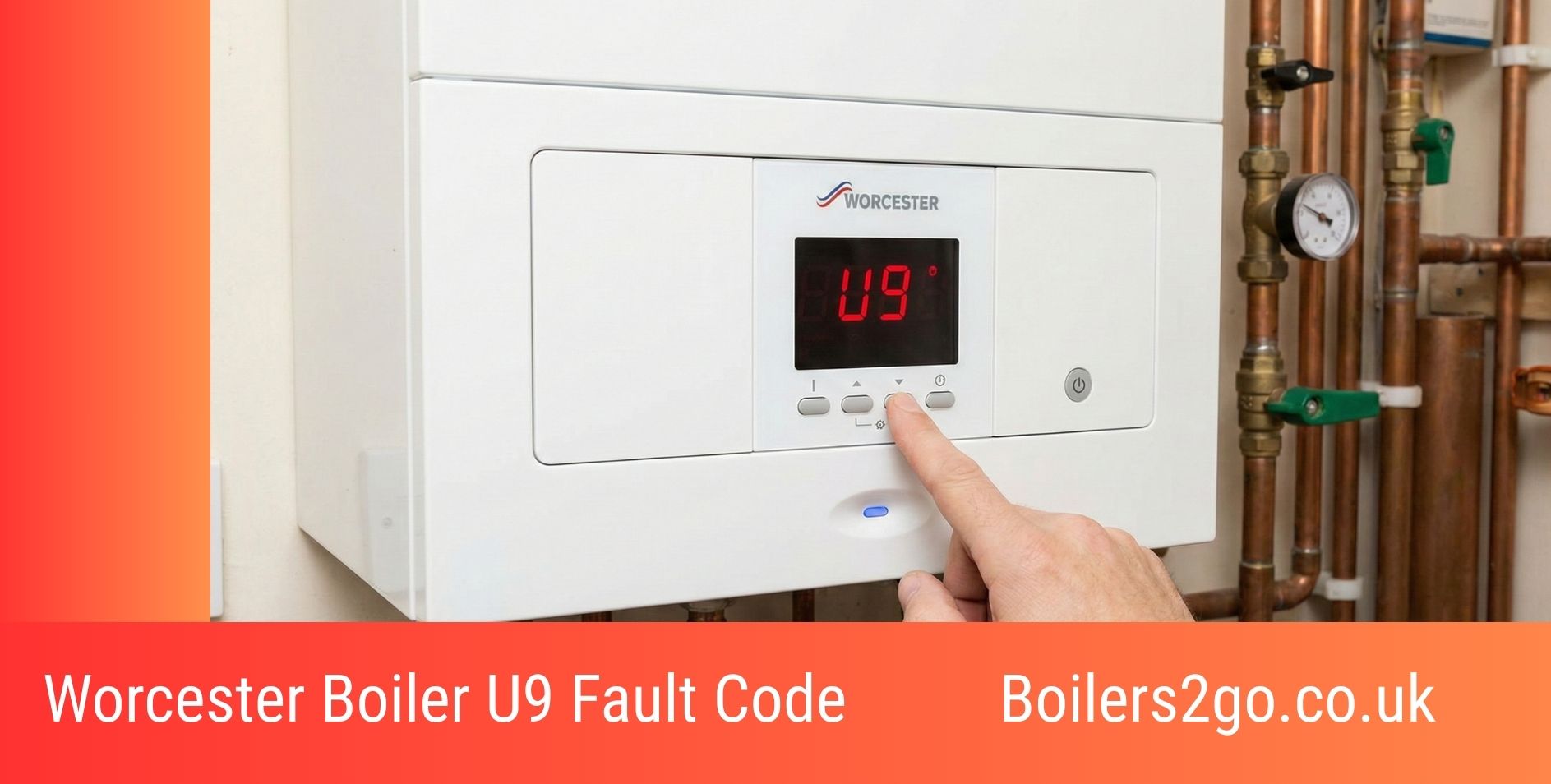
If your Worcester Bosch boiler is showing a U9 fault code, the heating has shut itself down because the flow temperature inside the unit climbed too high. This is not a glitch: U9 is a deliberate safety lockout designed to stop the boiler running in a state where it could damage itself or the wider system.
The good news is that U9 is one of the more diagnosable faults on the Greenstar range. The cause is almost always poor water circulation, which allows heat to build up in the heat exchanger faster than the system can carry it away. Knowing which specific cause applies to your boiler is the difference between a quick DIY fix and an unnecessary call-out fee.
This guide covers what U9 actually means, the most common causes across Worcester Bosch Greenstar models, what you can safely check yourself, and when to call a Gas Safe registered engineer.
Get a boiler repair and cover plan here >
What Is the Worcester Boiler U9 Fault Code?
The U9 code on a Worcester boiler indicates that the flow temperature inside the unit has exceeded the safe limit set by the boiler’s overheat protection. At that point, the boiler’s safety controls cut it off to prevent damage to the heat exchanger, pump, or printed circuit board (PCB). On many Greenstar models the lockout is also signalled by a flashing light on the control panel, and our guide to the Worcester Bosch boiler flashing blue light explains how to match the flash pattern to the fault.
On older two-digit display models such as the Greenstar CDi series, the display sometimes shows a countdown: U9 ticking down to U0 before a reset is allowed. This is the boiler enforcing a cool-down period before it will attempt to fire again. On newer models such as the Greenstar 4000 and 8000, a similar fault may appear as E9, sometimes with a three-digit cause code such as 219 (heat exchanger fault) or 220/221 (temperature limiter or sensor fault).
The U9 code is common across the Worcester Bosch Greenstar range used in UK homes and rental properties. For the wider fault code system, see our Worcester Bosch boiler error codes guide.
Watch Our Worcester U9 Fault Code Video
What Causes the U9 Fault Code on Worcester Boilers?
Every U9 fault comes back to the same core problem: heat building up in the boiler faster than the water can carry it away. The table below summarises the main causes and who is able to fix each one.
| Cause | What Happens | Who Fixes It |
|---|---|---|
| Low system pressure | Poor circulation triggers overheat sensor | DIY: repressurise to 1.2 bar |
| Blocked heat exchanger | Limescale or sludge restricts water flow | Gas Safe engineer: powerflush or replacement |
| Faulty circulation pump | Water stops moving; heat builds in exchanger | Gas Safe engineer: test and replace pump |
| Air locks in system | Hot spots develop; boiler trips | DIY: bleed radiators from lowest floor up |
| Faulty NTC thermistor | False temperature readings cause shutdown | Gas Safe engineer: thermistor replacement |
| Sludge build-up | Debris blocks pipes and radiators | Gas Safe engineer: chemical or powerflush |
A note on safety: some checks below are safe for any homeowner to carry out. Anything involving the internal components of a gas appliance, including the pump, heat exchanger, thermistor, or PCB, must be handled by a Gas Safe registered engineer. This is a legal requirement in the UK, not just a precaution.
Low Water Pressure
When system pressure drops below the recommended 1.0 to 1.5 bar, there is less water in the circuit to absorb and move heat away from the heat exchanger. The result is localised overheating and a U9 trip. This is one of the most frequent causes, particularly in older UK properties where the heating system is more prone to minor leaks.
How to Fix It
- Check the pressure gauge on the boiler front panel. It should read between 1.0 and 1.5 bar when the system is cold.
- If low, repressurise using the filling loop, which is usually a flexible braided hose beneath the boiler. Turn the valves slowly until the gauge reaches around 1.2 bar, then close them fully.
- If pressure keeps dropping after topping up, there is likely a leak somewhere in the system. Do not keep refilling: call a heating engineer to locate and repair it.
Blocked Heat Exchanger
The heat exchanger is where combustion heat transfers into the water that flows around your radiators and taps. When limescale, sludge, or debris builds up inside it, water flow slows and heat concentrates in one place until the overheat sensor trips. This is particularly common in hard water areas such as the South East of England, where limescale accumulates faster.
On Greenstar models, a blocked or failing heat exchanger sometimes shows the cause code 219 alongside E9 or U9. This is a strong indicator that the exchanger itself needs either a powerflush or replacement.
How to Fix It
- For moderate sludge build-up: a powerflush by a qualified engineer cleans the system and removes debris from radiators and pipework.
- For severe limescale or a heat exchanger that is already damaged: replacement is usually necessary. Costs vary but heat exchanger replacement on Greenstar models typically runs between £300 and £600 including parts and labour.
- Prevention: install a magnetic filter (such as a Magnaclean) and dose the system with inhibitor during annual servicing. This is the single most effective step for reducing future blockages.
Faulty Circulation Pump
The circulation pump is what keeps heated water moving around your home. If it seizes, runs weakly due to sludge, or develops an electrical fault, water sits in the heat exchanger and overheats quickly. A seized pump is often audible: the boiler may fire up briefly and then cut out, sometimes with a quiet hum but no water movement.
How to Fix It
- Listen for the pump: when the boiler fires, you should hear a gentle hum and feel warmth moving through nearby pipework within a minute or two. Silence suggests the pump is not running.
- Try a single reset. Occasionally a pump sticks temporarily and frees itself on restart.
- If the problem continues, a Gas Safe engineer should test the pump and replace it if necessary. Pump replacement on Worcester Greenstar boilers typically costs £150 to £300 including labour.
Air Locks in the System
Trapped air pockets in radiators or pipework prevent water from circulating freely, creating hot spots that push the boiler into U9 lockout. Air locks tend to develop after the system has been drained, following radiator changes, or in properties where upstairs radiators were recently bled without topping up the pressure.
How to Fix It
- Bleed your radiators, starting from the lowest floor and working upwards. Use a radiator bleed key to open the valve until water (not air) drips out steadily, then close it.
- After bleeding, check and top up the system pressure to 1.2 bar using the filling loop.
- If air keeps returning, there may be a small leak drawing air into the system. A Gas Safe engineer can pressure-test the circuit to identify it.
Defective Temperature Sensor (NTC Thermistor)
The NTC thermistor measures the flow temperature and sends that reading to the PCB. If the sensor becomes loose, corroded, or develops an internal fault, it can send a false high-temperature reading that triggers a U9 lockout even when the boiler is not actually overheating. Cause codes 220 and 221 on newer Greenstar models often point to this specific issue.
This is worth noting because a faulty thermistor is often one of the cheaper repairs available. An engineer can test the sensor with diagnostic tools and replace it if needed, with costs typically running between £100 and £200 including parts and labour.
How to Fix It
This requires a Gas Safe engineer with diagnostic equipment. Do not attempt to access or replace electrical components yourself. If U9 keeps appearing and there are no visible circulation issues, a thermistor fault is a strong possibility worth raising with the engineer before they start replacing more expensive parts.
System Sludge Build-Up
Over time, rust particles and debris from radiators, pipework, and the boiler itself accumulate into a thick black sludge that circulates through the system. This narrows internal passages, slows water flow, and eventually causes the heat exchanger to overheat. Sludge is common in unmaintained properties and systems that have never had a magnetic filter fitted.
How to Fix It
- A chemical flush involves introducing a cleaning agent to the system water, running it for a period, then draining and refilling. Suitable for light to moderate build-up.
- A powerflush uses high-pressure water to force debris out of the system. More effective for heavy build-up but more disruptive and expensive (typically £300 to £600 depending on system size).
- After either treatment, dose the system with a corrosion inhibitor and fit a magnetic filter to catch future debris before it builds up again.
How to Prevent the Worcester U9 Fault Code
Most U9 faults are preventable with regular maintenance. The steps below apply to all Worcester Bosch Greenstar models and are worth building into your annual routine.
- Annual servicing by a Gas Safe registered engineer. For rental properties, an annual gas safety check by a Gas Safe engineer (with a Gas Safety Record) is a legal requirement under the Gas Safety (Installation and Use) Regulations 1998; a full annual service is strongly recommended alongside it. A good service catches pressure issues, sludge build-up, and worn components before they cause a lockout.
- Monthly pressure checks. The gauge should read between 1.0 and 1.5 bar. A gradual drop over months suggests a slow leak that needs finding.
- Fit a magnetic filter if one is not already in place. Brands such as Magnaclean and Fernox TF1 are widely used and make a measurable difference to how quickly sludge accumulates.
- In hard water areas, consider a scale reducer or water softener to slow limescale build-up in the heat exchanger.
- Smart thermostats can help reduce unnecessary boiler cycling, which in turn reduces wear on the pump and heat exchanger over time.
If you are weighing up whether your current Worcester Bosch boiler is still worth maintaining, our guide on whether to repair or replace your boiler can help you decide.
Worcester Boiler U9 Fault Code: FAQs
Is the U9 Fault Code Specific to Certain Worcester Bosch Models?
The U9 code appears most frequently on older two-digit display models such as the Greenstar CDi series. On newer models including the Greenstar 4000 and 8000, a similar overheating fault may display as E9, sometimes with a three-digit cause code such as 219, 220, or 223 to help narrow down the specific component involved.
Can a U9 Fault Affect Your Worcester Bosch Warranty?
If your Worcester Bosch boiler is within its warranty period (typically 5 to 10 years depending on the model and installer), attempting DIY repairs beyond basic resets and pressure checks can void that cover. Always check your warranty status first and contact Worcester Bosch accredited boiler installers before authorising any internal repair work.
The Worcester Bosch reliability and performance comparison gives useful context on how Greenstar boilers hold up over time and what to expect at different stages of the boiler’s life. The Worcester Bosch boiler features review covers the technologies built into current models that can inform a repair-versus-replace decision.
What Should Landlords Do If Tenants Report a Worcester U9 Fault?
Treat it as urgent. Arrange a Gas Safe inspection promptly and document the fault and the engineer’s findings for your gas safety records. If the property is left without heating or hot water during cold weather, you may also have obligations under tenancy legislation. Emergency boiler cover plans reduce response times significantly for landlords managing multiple properties.
How Does Hard Water Contribute to Worcester U9 Errors?
High mineral content accelerates limescale formation inside the heat exchanger. Over time this narrows the waterways, slows circulation, and increases the frequency of U9 lockouts. In hard water areas such as much of southern England, fitting a scale reducer and servicing annually rather than every two years is a sensible approach.
Is There a Connection Between the Worcester U9 and E9 Codes?
Yes. On many Greenstar models, U9 and E9 are related overheating codes that can appear as part of the same fault sequence. U9 typically indicates the measured temperature has hit a critical threshold, while E9 signals the safety temperature limiter has tripped. Resolving the underlying circulation or sensor fault clears both. If you are seeing both codes, our Worcester boiler E9 fault code guide covers the limiter fault in detail.
How Many Times Should You Reset a Worcester Boiler Showing U9?
Once. Try a single reset after letting the boiler cool for 10 to 15 minutes. If U9 returns quickly after the boiler fires up again, stop and call a Gas Safe engineer. Repeatedly pressing reset forces the boiler to keep running in an overheating state, which risks damaging the heat exchanger or PCB, turning a moderate repair into a much more expensive one.

I’m Penny North, a home energy heating expert. My mission is to demystify new boilers and complex heating systems to help you achieve a warm, cosy home with lower energy bills and a smaller environmental footprint.